The Viscount, the architect and Phil Hogan

The shocking images from Japan since Friday are a frightening reminder of the fact that, for all our sophistication, even the most technologically advanced societies exist at the caprice of nature. Seeing large tracts of the north coast of Japan laid waste, with oil refineries in flames, nuclear plants severely damaged and infrastructure shattered may also be seen as a portent of what the next several decades have in store, not just for Japan, but for coastal areas – and beyond – all over the world.

While the earthquake that triggered the latest deadly tsunami is undoubtedly a geological incident, in September 2009 Prof Bill McGuire of University College London at the first major conference of scientists researching the changing climate’s effects on geological hazards said: “Climate change doesn’t just affect the atmosphere and the oceans but the earth’s crust as well. The whole earth is an interactive system.” Continue reading →

Posted in Global Warming, Irish Focus, Sceptics | Tagged , , , , , , , , | 9 Comments

Fine Gael and climate change – what’s the story?

Fine Gael will almost certainly comprise all or most of the incoming government, therefore what they have to say about policy matters a hell of a lot more than FF, Sinn Fein or the Greens, none of whom are likely to have any hand, act or part in government for quite some time. Labour may well yet have a significant say in the next administration (and if the alternate is a rag-bag of ‘independents’ propping up FG in exchange for parish pump favours, let’s hope so)

Fine Gael’s newly-published Manifesto has a section on ‘Environment & Climate Change’, which I reproduce below in full, to open a discussion. My own – very top line – comments are in brackets. Not included in this section is FG’s “policy” on peat bogs (burn, baby, burn, in short). It’s a shameful, gutless capitulation to what they clearly see as their rural “base”. Continue reading →

Posted in Global Warming, Irish Focus, Sustainability | Tagged , , , | 13 Comments

A Climate Bill Post-Mortem

Now that the Climate Change Response Bill 2010 has officially been consigned to the scrap heap, it is a good time to take stock of how the public debate around the Bill played out. As has already been discussed on this blog, the most vocal opponents of the Bill were IBEC, the IFA and the ICMSA.

In particular, the claim made by the IFA, based on research by Teagasc, that the introduction of this Bill would result in a 40% reduction in the national herd made a lot of headlines and helped stir up the farming community against the Bill. It also proved to be valuable fodder for Fine Gael Senators in the Second Stage Seanad debates that took place in January. In total, the research in question was directly referenced by four Fine Gael Senators (Paudie Coffey, Paul Coghlan, Paddy Burke and Joe O’Reilly) and an Independent with close agricultural ties (Feargal Quinn). Continue reading →

Posted in Economics, Global Warming, Irish Focus, Sustainability | Tagged , , , , , , , , , | 11 Comments

Smoke and mirrors in the attack on science

The BBC gets lots wrong. Its coverage of environmental and climate issues has wavered in the last year and more, in response not to new scientific evidence, but instead to growing pressure from the denialist lobby to turn climate science into a political hot potato that the Corporation seemed keen to drop as quickly as possible.

The rot stopped earlier this evening, with the broadcast on BBC 2 of a Horizon special, Science Under Attack, fronted by Nobel laureate Prof Paul Nurse, president of the UK’s Royal Society. At 350, the Society is the world’s oldest scientific body, and numbers many of the all-time giants of science, from Newton to Darwin, among its distinguished Fellows. Continue reading →

Posted in Global Warming, Media, Sceptics | 18 Comments

Monckton – not forcibly detaining Aids victims for life a mistake

The right honourable Lord Christopher Monckton, Third Viscount of Brenchley, former advisor to Maggie Thatcher, current the deputy leader of the UK Independence Party and darling of the US Tea Pary climate denialist circuit has done us the great honour of dropping over John Bull’s Other Island.

He’s here to share a platform with, ahem, like minded individuals here, these include Jim Corr, one-time drummer and now campaigner against the Illuminati(!) and the New World Order, an anti-vaccintion propagandist from the US and the editor of the far-right wing, ‘Sovereign Independent’ (typical headline: Two mothers and their toddler children banned from council-funded playgroup – for being BRITISH). This motley crew were lecturing under the banner of ‘The Truth Agenda’ in Cork last night and in Dublin tomorrow. Continue reading →

Posted in Global Warming, Media, Sceptics | 1 Comment

Mary Robinson – Reshaping the debate on climate change

For those of you who missed it in November, Mary Robinson’s lecture ‘Reshaping the debate on climate change’ is available to watch on YouTube now:

John has covered this lecture in a previous post, which I have taken the liberty of reproducing below:

Mary Robinson delivered a superb contribution to a packed audience in the Round Room of Dublin’s Mansion House. Her topic, in the EPA climate change series was: “Reshaping the debate on climate change”, and she pulled few punches.

There are, she pointed out, “powerful media figures giving oxygen to the (climate) deniers”. The main motivation of the media in this instance was, she argued, “of wanting a particular approach to governance” (i.e. laissez-faire economics). “Some within the media are very big players – Mr (Rupert) Murdoch is a problem – let’s call him by his name”, she said, to sustained applause.

The Murdoch press, notably Fox News in the US, has done untold damage to the fight against climate change and its toadying to corporatism; its media tentacles here in Ireland are extensive, from Sky News to the Sunday Times, The Sun and of course the News of the World (home of “columnist” Bertie-in-the-cabinet Ahern).

Robinson stated bluntly: “we’ve reached the limits of the the world’s development space”. Despite the current media-stoked spasm of denialism, “as climate events proliferate, their man-made causes will become ever more difficult to deny”. The current level of global economic growth of around 2% per annum “is simply not compatible with the urgent need to reduce emissions – even with a revolution in green technologies, it’s clear that stark choices lie ahead”.

As the atmospheric carrying capacity for CO2 is at or approaching critical levels, “the space for carbon-driven development no longer exists for developing countries. We’ve used up the (atmospheric) space for a safe world, we’ve been using it in a greedy way, we have confiscated this development space from the poor, and the poor are further paying for the ravages of climate change that they contributed little to create”.

We live, she added, “in a world of increasing intimacy; my carbon-rich lifestyle directly contributes to floods and droughts elsewhere, the good life we still enjoy here in Ireland has been built in part on the precariousness of the lives of climate refugees in Bangladesh”.

Despite the media panic-driven coverage of the very serious economic crisis in Ireland, “we don’t have the luxury of not attending to the longer term”, Robinson reminded her audience, in what was a commanding performance from a woman whose powers of reason, passion and persuasion remain undiminished after more than four decades of fighting the good fight.

Posted in Global Warming, Irish Focus, Media, Sustainability | 11 Comments

Denial and self-interested delusion on Climate Bill

The prolific US author, Upton Sinclair was a shrewd observer of human nature, as evidenced in his classic retort to vested interests: “It is difficult to get a man to understand something, when his salary depends upon his not understanding it!” He could have been directly addressing Danny McCoy and Neil Walker of IBEC or IFA president, John Bryan. All three have distinguished themselves with their rhetorical zeal in setting out doom-laden scenarios for the economy and agriculture if, perish the thought, Ireland were to legislate to fulfil its emissions reduction obligations as an EU member state (FoE has a useful summary of what the Bill is actually about here).

Hell no! It’s not a good time. Manana, manana. Let somebody else do it. It’s not out fault. Blame the Brazilians. Or was it the Chinese? Besides, everyone knows that dear old Ireland is too small/poor/rich/flat/green/religious/vegetarian/cold/wet etc. to be expected to shoulder any legal or moral responsibility for our actions. To recap: Ireland accounts for 68 million tonnes of CO2 emissions annually – that’s 17.5 tonnes per man, woman or child, or the equivalent of nearly 200 times our own weight produced by way of climate-altering emissions. Continue reading →

Posted in Global Warming, Irish Focus, Sustainability | Tagged , , , , , | 14 Comments

Media focus on climate disappears even faster than glaciers

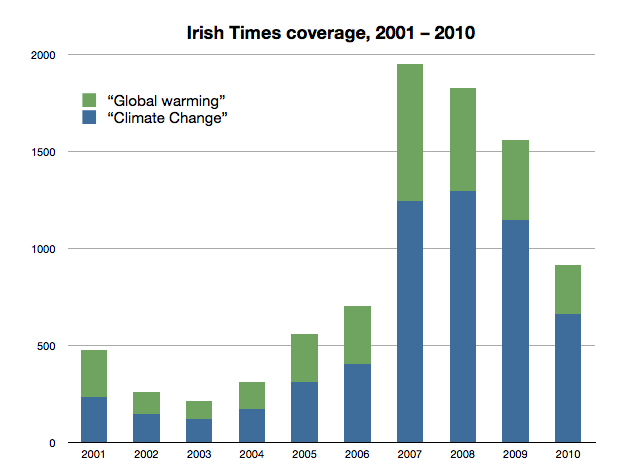
Global media coverage of climate change in 2010 fell to levels not seen since 2005, after spiking in late 2009 in the lead-in to the disastrous UN climate talks in Copenhagen and the theft and selective release of fragments of private emails from climate scientists at the CRU in East Anglia (‘Climategate’).

And Ireland? It’s difficult to get accurate information right across the board, as few news organisations’ websites allow systematic querying by date, so I used the Irish Times online archive for two reasons: first, because it is the ‘paper of record’ and second, its website allows accurate querying. I chose two discrete phrases, “global warming” and “climate change” and examined the frequency of their occurrence in the Irish Times over the last 10 years. The findings are summarised in the graph below:

The phrase “fallen off a cliff” is perhaps an overstatement, but it’s still pretty dramatic. Continue reading →

Posted in Global Warming, Media, Sceptics | Tagged , , | 5 Comments

Baby, it’s cold outside

News comes through this morning via John Gormley and Ciaran Cuffe that the Climate Change Response Bill has at last been published. A public consultation period on the Bill is to run until January 28th next, with a view to enactment in February – assuming, that is, the ragged Coalition can hold together that long.

Thanks to the wonders of WikiLeaks, we have some fascinating insights into the real state of play regarding Ireland and climate change in recent years. My favourite quote is from 2008, attributed to one Tom O’Mahony, described as an assistant secretary, DoE: Continue reading →

Posted in Global Warming, Irish Focus | Tagged , , , , , , , | 8 Comments

Carbon budget – yes, but Climate Bill remains elusive

Oisin Coghlan of FOE tweeted earlier today from Dail Eireann: “Carbon Budget. 4 Green TDs and all 3 senators in chamber/gallery. Phil Hogan for FG. 0 FF, 0 Lab, nobody else yet. Oh, and no journalists.” Yes, climate change may be the greatest challenge humanity has ever faced, it may well cause the collapse of industrial civilisation and mass die-offs within a couple of decades, but hey, that doesn’t make it NEWS or even vaguely interesting to politicians, apparently.

In all, just four TDs, and three Green senators watching from the gallery made it for the Carbon Budget being introduced by Environment Minister, John Gormley. If ever you needed confimation that, politically and media-wise, climate change is a dead letter, that’s about it. Continue reading →

Posted in Global Warming, Irish Focus, Media | Leave a comment

The not-so-strange paradox of global warming’s northern freeze

My article, below, as it appears in today’s Irish Times:

OPINION: The thaw is on (apparently); can this year’s two extreme cold snaps be linked to wider climate change?

AS 2010 draws to a close, globally it will enter the record books as a year of weather extremes. It is certain to be among the three hottest years since accurate global instrumental records began in 1850, and, despite the current cold spell over much of northern Europe, may well turn out to be the hottest.

The decade 2000-2009 has already been confirmed as the hottest yet recorded globally. The two regions now bearing the brunt of the heating are the Arctic/Greenland and sub-Saharan Africa. Continue reading →

Posted in Global Warming, Irish Focus | Tagged , , , , | 4 Comments

Septic tanks: another nettle in the long grass

It’s now more than a year since the European Court of Justice condemned Ireland for its dysfunctional approach to waste water treatment at some 500,000 premises across the State.

While work is underway to address the judgment, it will now fall to the next government to introduce an inspection and monitoring regime that complies with European law. Below is a piece I penned for Village Magazine earlier in the year. As the number of building starts has plummeted over the course of the year the percentage of one-off houses has shot up. Yes, it’s the law of small numbers: Celtic Tiger Ireland saw permission granted for 70,000 – 90,000 new homes a year. The first half of 2010 saw 3,059 new permissions – and 2,852 of these are one-off, 93%. Continue reading →

Posted in Global Warming, Irish Focus, Sustainability | Tagged , , , | 2 Comments

Is the chilling truth that we’re to blame for the big freeze?

The Irish Independent this morning has a useful full-page piece by Ed Power in its ‘Weekend Review’ section on the extreme cold spell. He canvassed three perspectives, and I find myself, not for the first time, somewhat at odds with Ray Bates, adjunct professor of meteorology in UCD.

I know Ray quite well, and always enjoy a friendly banter when we meet at conferences. I’ve listened to him speak on numerous occasions. His expertise and integrity is beyond question, but I reckon Ray is a disciple of the cup-half-full school, and appears to enjoy being a counterpoint to the ‘consensus view’ (among climate science, certainly, if not meteorology, a related but quite different discipline). “It is impossible to explain these large [weather] anomalies in terms of global warming”, Ray is quoted below.

He could as easily have pointed out that it is equally impossible to categorically rule out that we may well be experiencing a marked destabilisation in climate patterns. Globally, the evidence for systemic, wide-ranging and non-linear disturbances to climate systems is compelling. Ray appears to poo pooh these by harking back to the 1950s and scares about the possible climate impacts of atomic bomb tests. This is just a little reminiscent of the canard about climate science promising us a new ice age back in the 1970s (a favourite of lazy media commentators).

Meteorology is primarily about the study of weather, and weather is indeed a fickle beast, as Ray quite correctly points out. Climate science is about peering through the ‘noise’ of variability to reveal the underlying longer-term trends. Hence, the two disciplines often do not see eye to eye.

While I don’t share Ray’s view of underlying global warming being a slow-moving phenomenon, I unreservedly accept his bona fides in making the argument. The term ‘sceptic’ has come to be seen as a term of abuse in climate science. Genuine, informed scepticism is both welcome and necessary, and Ray Bates is, in that real sense, a sceptic.

==================================

From the Irish Independent:

So – is the Arctic weather all our own fault? Are we to blame for the blizzards and the icy mayhem? The mere question provokes a storm of disagreement among climate experts.

Some regard the unseasonable big freeze as irrefutable evidence that decades of human pollution have pushed existing climactic patterns to breaking point, unleashing a vengeful fury of extreme weather.

Others contend the snow storms buffeting the country, trapping thousands in their homes, are simply a statistical anomaly that have little to do with long-term trends in worldwide temperatures.

“The phrase ‘climate change’ may have to be retired in favour of ‘climate disruption’,” says Climatechange.ie founder John Gibbons. “Go back just a few years. In November 2009 we had record floods. January last. . . the worst freeze in 50 years. Now we’re back to it again.”

No single event, he says, can be attributed to climate change (which scientists believe is linked to the warming effects of greenhouse gases resulting from human activity). Cumulatively, however, it is clear profound changes are shaking global weather systems to their core.

“The rate we are seeing weather anomalies indicates something quite serious is happening with the climate system,” he says. “There are few people in expert circles who would disagree. The problem is they can’t tell you what would happen next. It’s like a runaway horse. It’s out of control and you don’t know what it’s going to do.”

There is, he acknowledges, an irony to the fact ‘global warming’ may be responsible for five inches of snow in Dublin. At a scientific level, however, this is a completely logical turn of events.

“When Ireland froze last January, weather stations in Greenland were recording temperature increases in the range of 3.8 to 8.8 degrees centigrade. They were completely off the chart.

“Weather systems are normally held within extremely cold areas such as the Arctic. Essentially, it’s too cold there for the ‘cold’ to move.

“What we’re seeing now is a weakening of the intense cold in the Arctic. That weakening is allowing the Arctic air to ‘slip away’ and so, of course, it lands on us. The cooling we are witnessing is mirrored by a dramatic warming in Greenland.”

Gibbons, an environmental writer and commentator, believes we are only seeing the start of things. “What does climate change and the warming effect tell us? It tells us we are going to get an intensification of storm activity and that we are going to get increased precipitation.

“That can include more snow, which might seem counter-intuitive.

“I know it can be difficult to explain, but snow falling from the sky can be a symptom of. . . increased warming. People are going to say, ‘that’s crazy’. Well, believe it or not — increased warming in cold areas can lead to more snow, not less.”

However, this opinion is not universally shared. “It is impossible to explain these large [weather] anomalies in terms of global warming,” says Ray Bates, adjunct Professor of Meteorology at UCD. “We are having a cold spell at the moment. The past two winters have been quite cold as well — colder than normal, after decades in which there was very little frost. These are local anomalies in the Irish climate.”

That’s not to say global warming hasn’t impacted on the weather, he says. It’s just that the changes are long-term and, compared to the current blizzards, relatively subtle.

“We’ve had a lot of variability in the last few years in Irish weather,” says Prof Bates. “We’ve had very wet summers in 2008 and 2009. We’ve had three winters in which we’ve had a lot of cold weather. We had ice on Sandymount Strand in January 2009.

“This year we have the record November cold spell. These are features of the natural variability in our climate. In the background, we’ve had global warming going on. The main signal of global warming, which we can attribute to greenhouse gas increases, is the rise in sea level, which is occurring at 3.2mm per year.”

Rising sea levels aren’t to be scoffed at. Nonetheless, they are unlikely to have triggered the current severe weather, he says. “A lot of commentators are saying this is a sign of man-made climate change. I wouldn’t agree with that at all. [Climate change] would lead to some extra warming in the atmosphere and to some excess rainfall — but nothing to the extent of the anomalies we have seen in our recent wet summers.

“The rainfall November of last year was 200pc to 300pc above normal. What you’d expect from global warming would be a 6pc or 7pc increase in average rainfall due to temperature increases.”

There is a third school of thought. Some scientists believe global warming is not the only factor behind the weather extremes of the past two years or so. According to Professor Michael Lockwood of the department of meteorology at the University of Reading, changes on the surface of the sun may play a role too.

At the moment, he says, the sun is going through a period of ‘low’ activity, with less sunspot agitation than normal (sunspots are areas of intense heat on the surface of the sun, visible as dark blots). When this is combined with high-altitude jet-stream winds, as is happening presently, it gives rise to a phenomenon he describes as ‘jet-stream blocking’.

Over the next few years, he says, the likely result will be colder winters and heavier snowfall. “It looked last week like we had a blocking event formed. The phenomenon is really a snaking of the jet stream. It can start to pull lower altitude, cold Russian air back in over Europe,” he said.

“November is a pretty good predictor of what December through February is going to be like.”

Not everyone goes along with this. People are seeking an explanation for freak weather when none may exist, says Prof Bates.

“People are always looking for reasons for anomalies. I’m old enough to remember the 1950s, when people were blaming the atomic bomb tests for causing what was considered strange weather. The variability in our climate has always been there and will always be there whilst in the background we have global warming, which is slowly starting to be felt,” he says.

In the opposite camp, Climatechange.ie believes that the extreme weather is likely to grow even more extreme in the decades ahead. “We appear to be at the end of a very long, benign period,” says Gibbons.

“The climactic conditions that allowed humanity to prosper are [over]. We may have to brace for more of this. I think we are in an incredibly dangerous position.

“The time for getting the reins back on the horse is running out. The first thing you’ve got to do in a crisis is recognise there is a crisis.”

Posted in Global Warming, Irish Focus | Tagged , , , , | 12 Comments

Debate on COP 16 in Cancun has been muted at best. The IIEA research and design teams have prepared a simple info-gram which illustrates the negotiation positions of the seven key actors, including their commitments, priorities and respective emissions as they enter negotiations at the Cancun Conference.

A full briefing note and the Cancun-o-Gram are available to download here.

Posted in Global Warming | Tagged , , | Leave a comment

Greetings from 1930: a book extract

You might have thought that the last decade, and back in the 1980s, were the first occasions that banking in Ireland lost the run of itself, throwing our collective future in jeopardy. Not so. Or that the decade to 2008 was really the first time brashness and lust for material things rose in Ireland with abandon. Again, not so.

For Irish agriculture the Great War, 1914 – 1918, was a boon. Exports to Britain soared: with imports from anywhere but Ireland severely limited, the price of Irish produce was bid up accordingly.

In and around 1930, John Nix, a relative of mine born in 1884, penned a book and I’m giving my cousin, Des Nix, a hand with editing, (and yes, we’re on the look out for a publisher!).

Des describes John as one of the old-type gentlemen journalists, a scholar of Greek and Latin. Over his life he worked for the Carlow Nationalist, the New Ross Free Press and was a columnist with the Irish Independent, writing under the pen name of Sean Sneachta. His earlier years he spent in Clare and Limerick.

In the extract below John discusses the role of banks in the Ireland of 1914 to 1921. Historical comparisons are tricky but it was a time when agriculture would have held a position in Ireland even more central than the role construction came to play in the ten years to 2008.

The piece goes some way to explaining why Ireland never had a roaring twenties. More pertinently, it makes us question for how long more we will enslave our society to a banking system prone to inflict such damage. Given the striking parallels with today, I came away thinking: for how long more will we permit this?

While the extract below ends darkly, elsewhere John Nix is upbeat on the prospects for the young nation saying “the Celt has qualities not unlike the camomile flower – the more it is trodden on, the more it grows”.

Extracted from Chapter 3 –
“The long-dreaded landlord is, or soon will be, a thing of the past, but the joint stock banks are taking their place. During the war, and in fact till the great slump came in the May of 1921, the price of land increased five-fold because bank managers went about to sales and auctions pressing money on would-be purchasers.

Many of them sold out their small places and bought big farms, making up the difference with money pressed on them by the banks. As we are tied on to the English money system, we suffered tremendously when that country embarked on a policy of deflation.

The prices of livestock and farming produce fell to less than half inside of a year and continued to fall until the present time. The result of all this is that the farmer who is stuck in a bank finds it two or three times more difficult to pay interest today than during the boom years. The position is really desperate at present for the vast majority of our farmers.

… the farmers lived up to their means and even beyond it during those boom years. They bought motors, spent tons of money on drink and abandoned themselves to a life of dissipation generally.

… They thought the boom years would last forever, especially as they lasted for two and a half years after the Great War.

…Every scraggy farmer having more money than he ever thought he would have looked out for the time when he would be a great territorial magnate. They began to ape the landlords – what was left of them – and the gentry.

Sudden wealth is a dangerous thing. The farmers had seven glorious years. They lived a sort of earthly paradise and now they are cast into the outer regions, pervaded as they are by doubt, debt, depression and disappointment.

In fact , some of them go so far as to say now that it would be better that they never saw such boom years. They have unfitted them for the stern struggle of today.

If the banks really wanted to do it they could put half the farmers of Ireland on the roadside nowadays they owe them such a pile of money.

… has it ever struck you that when a man owes you too much money that he becomes in a sense your master. If you come down upon him like a load of bricks you scotch him altogether and you get no more out of him. These creditors will have to wait and see and in any case a lot of their money will be irrecoverably lost in the long run.

… banks, unlike private traders, never die, and debts owing to them never grow stale. They are continued in their books from one generation to another. Many an ambitious man has tied a millstone of debt around the necks of his children as won’t be paid to the banks for the next fifty years.”

Posted in Economics, Global Warming, Irish Focus | Tagged , , , | 2 Comments