The Stockholm Memorandum – 3rd Nobel Laureate Symposium* on Global Sustainability, Stockholm, Sweden, 16-19 May 2011
I. Mind-shift for a Great Transformation
The Earth system is complex. There are many aspects that we do not yet understand. However, we are the first generation with the insight of the new global risks facing humanity. We face the evidence that our progress as the dominant species has come at a very high price.
Unsustainable patterns of production, consumption, and population growth are challenging the resilience of the planet to support human activity. At the same time, inequalities between and within societies remain high, leaving behind billions with unmet basic human needs and disproportionate vulnerability to global environmental change. Continue reading →
“Prediction is very difficult, especially about the future”, the famous Danish physicist Niels Bohr once quipped, only half in jest.
Scientists, as we know, are a dry lot, preferring to leave the purple prose to the scribes while they pore over their beakers and field samples, tut tutting all the while at the misrepresentation and distortions in much of what passes for coverage of science generally (and the benighted and ideologue-infested sub-field of ‘climate economics’ in particular).
Dr James Powell is an exception. He has identified (correctly, in my view) that societies communicate more in storytelling and myths than in the recital of cold data, assessments and reports. Simply setting out the facts, as the IPCC and countless other worthy organisations have found to their cost, gets you nowhere, especially Continue reading →
“My God, my God, why hath thou forsaken me?” These are the words attributed to Christ on the cross, as recorded in two of the Gospels (Matthew and Mark). It is one of what are known as the ‘Seven Last Words’. An editorial in today’s Irish Times waxes lyrical about their apparent continued relevance: “Workers who have lost their jobs, families who have lost their homes, emigrants, migrants, the struggling people of Libya and the Middle East, all can echo the cry of anguish from a Christ who wonders whether he has been forsaken.”
Oddly enough, it always sounded to me a lot like a prophet who, in the course of being put to death for the beliefs he so earnestly held and professed, suddenly realised that this was it: he was about to die, just the same as every other flesh-and-blood human being. Frankly, this altogether human story is, to my ear, far more plausible and compelling than the more fanciful fables that have come to dominate our understanding of the life and death of Jesus of Nazareth. Continue reading →
I’ve been following the unfolding nuclear “crisis” in Japan with growing alarm. People who call themselves environmentalists have been jumping up and down with thinly disguised glee, pointing and waving and saying: “there, we warned you, nuclear is GONNA KILL US ALL”. Run for your lives, a plume of deadly radiation is spreading across the planet. We’re doomed, I tells ya, doomed.
And in a sense, they are right. Events at Fukushima have indeed taken the world a significant step closer to Carbon Armageddon. Continue reading →
The shocking images from Japan since Friday are a frightening reminder of the fact that, for all our sophistication, even the most technologically advanced societies exist at the caprice of nature. Seeing large tracts of the north coast of Japan laid waste, with oil refineries in flames, nuclear plants severely damaged and infrastructure shattered may also be seen as a portent of what the next several decades have in store, not just for Japan, but for coastal areas – and beyond – all over the world.
While the earthquake that triggered the latest deadly tsunami is undoubtedly a geological incident, in September 2009 Prof Bill McGuire of University College London at the first major conference of scientists researching the changing climate’s effects on geological hazards said: “Climate change doesn’t just affect the atmosphere and the oceans but the earth’s crust as well. The whole earth is an interactive system.” Continue reading →
Fine Gael will almost certainly comprise all or most of the incoming government, therefore what they have to say about policy matters a hell of a lot more than FF, Sinn Fein or the Greens, none of whom are likely to have any hand, act or part in government for quite some time. Labour may well yet have a significant say in the next administration (and if the alternate is a rag-bag of ‘independents’ propping up FG in exchange for parish pump favours, let’s hope so)
Fine Gael’s newly-published Manifesto has a section on ‘Environment & Climate Change’, which I reproduce below in full, to open a discussion. My own – very top line – comments are in brackets. Not included in this section is FG’s “policy” on peat bogs (burn, baby, burn, in short). It’s a shameful, gutless capitulation to what they clearly see as their rural “base”. Continue reading →
Now that the Climate Change Response Bill 2010 has officially been consigned to the scrap heap, it is a good time to take stock of how the public debate around the Bill played out. As has already been discussed on this blog, the most vocal opponents of the Bill were IBEC, the IFA and the ICMSA.
In particular, the claim made by the IFA, based on research by Teagasc, that the introduction of this Bill would result in a 40% reduction in the national herd made a lot of headlines and helped stir up the farming community against the Bill. It also proved to be valuable fodder for Fine Gael Senators in the Second Stage Seanad debates that took place in January. In total, the research in question was directly referenced by four Fine Gael Senators (Paudie Coffey, Paul Coghlan, Paddy Burke and Joe O’Reilly) and an Independent with close agricultural ties (Feargal Quinn). Continue reading →
The BBC gets lots wrong. Its coverage of environmental and climate issues has wavered in the last year and more, in response not to new scientific evidence, but instead to growing pressure from the denialist lobby to turn climate science into a political hot potato that the Corporation seemed keen to drop as quickly as possible.
The rot stopped earlier this evening, with the broadcast on BBC 2 of a Horizon special, Science Under Attack, fronted by Nobel laureate Prof Paul Nurse, president of the UK’s Royal Society. At 350, the Society is the world’s oldest scientific body, and numbers many of the all-time giants of science, from Newton to Darwin, among its distinguished Fellows. Continue reading →
The right honourable Lord Christopher Monckton, Third Viscount of Brenchley, former advisor to Maggie Thatcher, current the deputy leader of the UK Independence Party and darling of the US Tea Pary climate denialist circuit has done us the great honour of dropping over John Bull’s Other Island.
He’s here to share a platform with, ahem, like minded individuals here, these include Jim Corr, one-time drummer and now campaigner against the Illuminati(!) and the New World Order, an anti-vaccintion propagandist from the US and the editor of the far-right wing, ‘Sovereign Independent’ (typical headline: Two mothers and their toddler children banned from council-funded playgroup – for being BRITISH). This motley crew were lecturing under the banner of ‘The Truth Agenda’ in Cork last night and in Dublin tomorrow. Continue reading →
For those of you who missed it in November, Mary Robinson’s lecture ‘Reshaping the debate on climate change’ is available to watch on YouTube now:
John has covered this lecture in a previous post, which I have taken the liberty of reproducing below:
Mary Robinson delivered a superb contribution to a packed audience in the Round Room of Dublin’s Mansion House. Her topic, in the EPA climate change series was: “Reshaping the debate on climate change”, and she pulled few punches.
There are, she pointed out, “powerful media figures giving oxygen to the (climate) deniers”. The main motivation of the media in this instance was, she argued, “of wanting a particular approach to governance” (i.e. laissez-faire economics). “Some within the media are very big players – Mr (Rupert) Murdoch is a problem – let’s call him by his name”, she said, to sustained applause.
The Murdoch press, notably Fox News in the US, has done untold damage to the fight against climate change and its toadying to corporatism; its media tentacles here in Ireland are extensive, from Sky News to the Sunday Times, The Sun and of course the News of the World (home of “columnist” Bertie-in-the-cabinet Ahern).
Robinson stated bluntly: “we’ve reached the limits of the the world’s development space”. Despite the current media-stoked spasm of denialism, “as climate events proliferate, their man-made causes will become ever more difficult to deny”. The current level of global economic growth of around 2% per annum “is simply not compatible with the urgent need to reduce emissions – even with a revolution in green technologies, it’s clear that stark choices lie ahead”.
As the atmospheric carrying capacity for CO2 is at or approaching critical levels, “the space for carbon-driven development no longer exists for developing countries. We’ve used up the (atmospheric) space for a safe world, we’ve been using it in a greedy way, we have confiscated this development space from the poor, and the poor are further paying for the ravages of climate change that they contributed little to create”.
We live, she added, “in a world of increasing intimacy; my carbon-rich lifestyle directly contributes to floods and droughts elsewhere, the good life we still enjoy here in Ireland has been built in part on the precariousness of the lives of climate refugees in Bangladesh”.
Despite the media panic-driven coverage of the very serious economic crisis in Ireland, “we don’t have the luxury of not attending to the longer term”, Robinson reminded her audience, in what was a commanding performance from a woman whose powers of reason, passion and persuasion remain undiminished after more than four decades of fighting the good fight.
The prolific US author, Upton Sinclair was a shrewd observer of human nature, as evidenced in his classic retort to vested interests: “It is difficult to get a man to understand something, when his salary depends upon his not understanding it!” He could have been directly addressing Danny McCoy and Neil Walker of IBEC or IFA president, John Bryan. All three have distinguished themselves with their rhetorical zeal in setting out doom-laden scenarios for the economy and agriculture if, perish the thought, Ireland were to legislate to fulfil its emissions reduction obligations as an EU member state (FoE has a useful summary of what the Bill is actually about here).
Hell no! It’s not a good time. Manana, manana. Let somebody else do it. It’s not out fault. Blame the Brazilians. Or was it the Chinese? Besides, everyone knows that dear old Ireland is too small/poor/rich/flat/green/religious/vegetarian/cold/wet etc. to be expected to shoulder any legal or moral responsibility for our actions. To recap: Ireland accounts for 68 million tonnes of CO2 emissions annually – that’s 17.5 tonnes per man, woman or child, or the equivalent of nearly 200 times our own weight produced by way of climate-altering emissions. Continue reading →
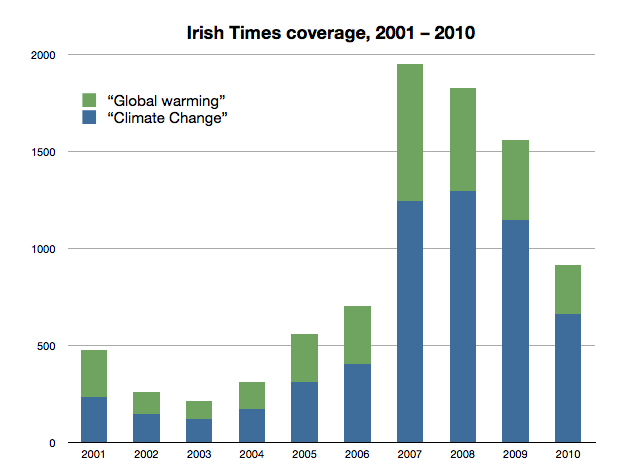
Global media coverage of climate change in 2010 fell to levels not seen since 2005, after spiking in late 2009 in the lead-in to the disastrous UN climate talks in Copenhagen and the theft and selective release of fragments of private emails from climate scientists at the CRU in East Anglia (‘Climategate’).
And Ireland? It’s difficult to get accurate information right across the board, as few news organisations’ websites allow systematic querying by date, so I used the Irish Times online archive for two reasons: first, because it is the ‘paper of record’ and second, its website allows accurate querying. I chose two discrete phrases, “global warming” and “climate change” and examined the frequency of their occurrence in the Irish Times over the last 10 years. The findings are summarised in the graph below:
The phrase “fallen off a cliff” is perhaps an overstatement, but it’s still pretty dramatic. Continue reading →
News comes through this morning via John Gormley and Ciaran Cuffe that the Climate Change Response Bill has at last been published. A public consultation period on the Bill is to run until January 28th next, with a view to enactment in February – assuming, that is, the ragged Coalition can hold together that long.
Thanks to the wonders of WikiLeaks, we have some fascinating insights into the real state of play regarding Ireland and climate change in recent years. My favourite quote is from 2008, attributed to one Tom O’Mahony, described as an assistant secretary, DoE: Continue reading →
Oisin Coghlan of FOE tweeted earlier today from Dail Eireann: “Carbon Budget. 4 Green TDs and all 3 senators in chamber/gallery. Phil Hogan for FG. 0 FF, 0 Lab, nobody else yet. Oh, and no journalists.” Yes, climate change may be the greatest challenge humanity has ever faced, it may well cause the collapse of industrial civilisation and mass die-offs within a couple of decades, but hey, that doesn’t make it NEWS or even vaguely interesting to politicians, apparently.
In all, just four TDs, and three Green senators watching from the gallery made it for the Carbon Budget being introduced by Environment Minister, John Gormley. If ever you needed confimation that, politically and media-wise, climate change is a dead letter, that’s about it. Continue reading →
My article, below, as it appears in today’s Irish Times:
OPINION: The thaw is on (apparently); can this year’s two extreme cold snaps be linked to wider climate change?
AS 2010 draws to a close, globally it will enter the record books as a year of weather extremes. It is certain to be among the three hottest years since accurate global instrumental records began in 1850, and, despite the current cold spell over much of northern Europe, may well turn out to be the hottest.
The decade 2000-2009 has already been confirmed as the hottest yet recorded globally. The two regions now bearing the brunt of the heating are the Arctic/Greenland and sub-Saharan Africa. Continue reading →