Denial and self-interested delusion on Climate Bill

The prolific US author, Upton Sinclair was a shrewd observer of human nature, as evidenced in his classic retort to vested interests: “It is difficult to get a man to understand something, when his salary depends upon his not understanding it!” He could have been directly addressing Danny McCoy and Neil Walker of IBEC or IFA president, John Bryan. All three have distinguished themselves with their rhetorical zeal in setting out doom-laden scenarios for the economy and agriculture if, perish the thought, Ireland were to legislate to fulfil its emissions reduction obligations as an EU member state (FoE has a useful summary of what the Bill is actually about here).

Hell no! It’s not a good time. Manana, manana. Let somebody else do it. It’s not out fault. Blame the Brazilians. Or was it the Chinese? Besides, everyone knows that dear old Ireland is too small/poor/rich/flat/green/religious/vegetarian/cold/wet etc. to be expected to shoulder any legal or moral responsibility for our actions. To recap: Ireland accounts for 68 million tonnes of CO2 emissions annually – that’s 17.5 tonnes per man, woman or child, or the equivalent of nearly 200 times our own weight produced by way of climate-altering emissions. Continue reading

Posted in Global Warming, Irish Focus, Sustainability | Tagged , , , , , | 14 Comments

Media focus on climate disappears even faster than glaciers

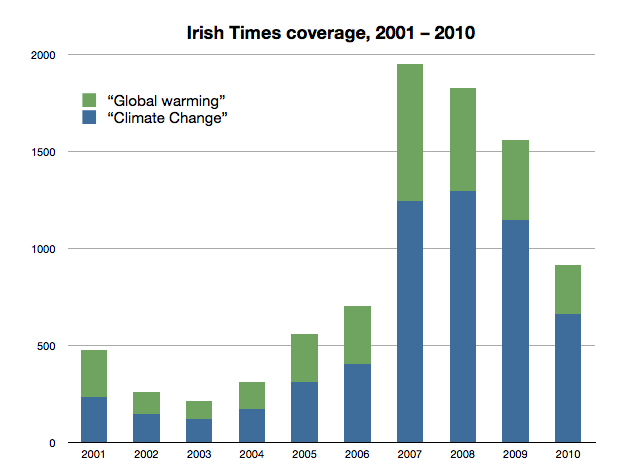
Global media coverage of climate change in 2010 fell to levels not seen since 2005, after spiking in late 2009 in the lead-in to the disastrous UN climate talks in Copenhagen and the theft and selective release of fragments of private emails from climate scientists at the CRU in East Anglia (‘Climategate’).

And Ireland? It’s difficult to get accurate information right across the board, as few news organisations’ websites allow systematic querying by date, so I used the Irish Times online archive for two reasons: first, because it is the ‘paper of record’ and second, its website allows accurate querying. I chose two discrete phrases, “global warming” and “climate change” and examined the frequency of their occurrence in the Irish Times over the last 10 years. The findings are summarised in the graph below:

The phrase “fallen off a cliff” is perhaps an overstatement, but it’s still pretty dramatic. Continue reading

Posted in Global Warming, Media, Sceptics | Tagged , , | 5 Comments

Baby, it’s cold outside

News comes through this morning via John Gormley and Ciaran Cuffe that the Climate Change Response Bill has at last been published. A public consultation period on the Bill is to run until January 28th next, with a view to enactment in February – assuming, that is, the ragged Coalition can hold together that long.

Thanks to the wonders of WikiLeaks, we have some fascinating insights into the real state of play regarding Ireland and climate change in recent years. My favourite quote is from 2008, attributed to one Tom O’Mahony, described as an assistant secretary, DoE: Continue reading

Posted in Global Warming, Irish Focus | Tagged , , , , , , , | 8 Comments

Carbon budget – yes, but Climate Bill remains elusive

Oisin Coghlan of FOE tweeted earlier today from Dail Eireann: “Carbon Budget. 4 Green TDs and all 3 senators in chamber/gallery. Phil Hogan for FG. 0 FF, 0 Lab, nobody else yet. Oh, and no journalists.” Yes, climate change may be the greatest challenge humanity has ever faced, it may well cause the collapse of industrial civilisation and mass die-offs within a couple of decades, but hey, that doesn’t make it NEWS or even vaguely interesting to politicians, apparently.

In all, just four TDs, and three Green senators watching from the gallery made it for the Carbon Budget being introduced by Environment Minister, John Gormley. If ever you needed confimation that, politically and media-wise, climate change is a dead letter, that’s about it. Continue reading

Posted in Global Warming, Irish Focus, Media | Leave a comment

The not-so-strange paradox of global warming’s northern freeze

My article, below, as it appears in today’s Irish Times:

OPINION: The thaw is on (apparently); can this year’s two extreme cold snaps be linked to wider climate change?

AS 2010 draws to a close, globally it will enter the record books as a year of weather extremes. It is certain to be among the three hottest years since accurate global instrumental records began in 1850, and, despite the current cold spell over much of northern Europe, may well turn out to be the hottest.

The decade 2000-2009 has already been confirmed as the hottest yet recorded globally. The two regions now bearing the brunt of the heating are the Arctic/Greenland and sub-Saharan Africa. Continue reading

Posted in Global Warming, Irish Focus | Tagged , , , , | 4 Comments

Septic tanks: another nettle in the long grass

It’s now more than a year since the European Court of Justice condemned Ireland for its dysfunctional approach to waste water treatment at some 500,000 premises across the State.

While work is underway to address the judgment, it will now fall to the next government to introduce an inspection and monitoring regime that complies with European law. Below is a piece I penned for Village Magazine earlier in the year. As the number of building starts has plummeted over the course of the year the percentage of one-off houses has shot up. Yes, it’s the law of small numbers: Celtic Tiger Ireland saw permission granted for 70,000 – 90,000 new homes a year. The first half of 2010 saw 3,059 new permissions – and 2,852 of these are one-off, 93%. Continue reading

Posted in Global Warming, Irish Focus, Sustainability | Tagged , , , | 2 Comments

Is the chilling truth that we’re to blame for the big freeze?

The Irish Independent this morning has a useful full-page piece by Ed Power in its ‘Weekend Review’ section on the extreme cold spell. He canvassed three perspectives, and I find myself, not for the first time, somewhat at odds with Ray Bates, adjunct professor of meteorology in UCD.

I know Ray quite well, and always enjoy a friendly banter when we meet at conferences. I’ve listened to him speak on numerous occasions. His expertise and integrity is beyond question, but I reckon Ray is a disciple of the cup-half-full school, and appears to enjoy being a counterpoint to the ‘consensus view’ (among climate science, certainly, if not meteorology, a related but quite different discipline). “It is impossible to explain these large [weather] anomalies in terms of global warming”, Ray is quoted below.

He could as easily have pointed out that it is equally impossible to categorically rule out that we may well be experiencing a marked destabilisation in climate patterns. Globally, the evidence for systemic, wide-ranging and non-linear disturbances to climate systems is compelling. Ray appears to poo pooh these by harking back to the 1950s and scares about the possible climate impacts of atomic bomb tests. This is just a little reminiscent of the canard about climate science promising us a new ice age back in the 1970s (a favourite of lazy media commentators).

Meteorology is primarily about the study of weather, and weather is indeed a fickle beast, as Ray quite correctly points out. Climate science is about peering through the ‘noise’ of variability to reveal the underlying longer-term trends. Hence, the two disciplines often do not see eye to eye.

While I don’t share Ray’s view of underlying global warming being a slow-moving phenomenon, I unreservedly accept his bona fides in making the argument. The term ‘sceptic’ has come to be seen as a term of abuse in climate science. Genuine, informed scepticism is both welcome and necessary, and Ray Bates is, in that real sense, a sceptic.

==================================

From the Irish Independent:

So – is the Arctic weather all our own fault? Are we to blame for the blizzards and the icy mayhem? The mere question provokes a storm of disagreement among climate experts.

Some regard the unseasonable big freeze as irrefutable evidence that decades of human pollution have pushed existing climactic patterns to breaking point, unleashing a vengeful fury of extreme weather.

Others contend the snow storms buffeting the country, trapping thousands in their homes, are simply a statistical anomaly that have little to do with long-term trends in worldwide temperatures.

“The phrase ‘climate change’ may have to be retired in favour of ‘climate disruption’,” says Climatechange.ie founder John Gibbons. “Go back just a few years. In November 2009 we had record floods. January last. . . the worst freeze in 50 years. Now we’re back to it again.”

No single event, he says, can be attributed to climate change (which scientists believe is linked to the warming effects of greenhouse gases resulting from human activity). Cumulatively, however, it is clear profound changes are shaking global weather systems to their core.

“The rate we are seeing weather anomalies indicates something quite serious is happening with the climate system,” he says. “There are few people in expert circles who would disagree. The problem is they can’t tell you what would happen next. It’s like a runaway horse. It’s out of control and you don’t know what it’s going to do.”

There is, he acknowledges, an irony to the fact ‘global warming’ may be responsible for five inches of snow in Dublin. At a scientific level, however, this is a completely logical turn of events.

“When Ireland froze last January, weather stations in Greenland were recording temperature increases in the range of 3.8 to 8.8 degrees centigrade. They were completely off the chart.

“Weather systems are normally held within extremely cold areas such as the Arctic. Essentially, it’s too cold there for the ‘cold’ to move.

“What we’re seeing now is a weakening of the intense cold in the Arctic. That weakening is allowing the Arctic air to ‘slip away’ and so, of course, it lands on us. The cooling we are witnessing is mirrored by a dramatic warming in Greenland.”

Gibbons, an environmental writer and commentator, believes we are only seeing the start of things. “What does climate change and the warming effect tell us? It tells us we are going to get an intensification of storm activity and that we are going to get increased precipitation.

“That can include more snow, which might seem counter-intuitive.

“I know it can be difficult to explain, but snow falling from the sky can be a symptom of. . . increased warming. People are going to say, ‘that’s crazy’. Well, believe it or not — increased warming in cold areas can lead to more snow, not less.”

However, this opinion is not universally shared. “It is impossible to explain these large [weather] anomalies in terms of global warming,” says Ray Bates, adjunct Professor of Meteorology at UCD. “We are having a cold spell at the moment. The past two winters have been quite cold as well — colder than normal, after decades in which there was very little frost. These are local anomalies in the Irish climate.”

That’s not to say global warming hasn’t impacted on the weather, he says. It’s just that the changes are long-term and, compared to the current blizzards, relatively subtle.

“We’ve had a lot of variability in the last few years in Irish weather,” says Prof Bates. “We’ve had very wet summers in 2008 and 2009. We’ve had three winters in which we’ve had a lot of cold weather. We had ice on Sandymount Strand in January 2009.

“This year we have the record November cold spell. These are features of the natural variability in our climate. In the background, we’ve had global warming going on. The main signal of global warming, which we can attribute to greenhouse gas increases, is the rise in sea level, which is occurring at 3.2mm per year.”

Rising sea levels aren’t to be scoffed at. Nonetheless, they are unlikely to have triggered the current severe weather, he says. “A lot of commentators are saying this is a sign of man-made climate change. I wouldn’t agree with that at all. [Climate change] would lead to some extra warming in the atmosphere and to some excess rainfall — but nothing to the extent of the anomalies we have seen in our recent wet summers.

“The rainfall November of last year was 200pc to 300pc above normal. What you’d expect from global warming would be a 6pc or 7pc increase in average rainfall due to temperature increases.”

There is a third school of thought. Some scientists believe global warming is not the only factor behind the weather extremes of the past two years or so. According to Professor Michael Lockwood of the department of meteorology at the University of Reading, changes on the surface of the sun may play a role too.

At the moment, he says, the sun is going through a period of ‘low’ activity, with less sunspot agitation than normal (sunspots are areas of intense heat on the surface of the sun, visible as dark blots). When this is combined with high-altitude jet-stream winds, as is happening presently, it gives rise to a phenomenon he describes as ‘jet-stream blocking’.

Over the next few years, he says, the likely result will be colder winters and heavier snowfall. “It looked last week like we had a blocking event formed. The phenomenon is really a snaking of the jet stream. It can start to pull lower altitude, cold Russian air back in over Europe,” he said.

“November is a pretty good predictor of what December through February is going to be like.”

Not everyone goes along with this. People are seeking an explanation for freak weather when none may exist, says Prof Bates.

“People are always looking for reasons for anomalies. I’m old enough to remember the 1950s, when people were blaming the atomic bomb tests for causing what was considered strange weather. The variability in our climate has always been there and will always be there whilst in the background we have global warming, which is slowly starting to be felt,” he says.

In the opposite camp, Climatechange.ie believes that the extreme weather is likely to grow even more extreme in the decades ahead. “We appear to be at the end of a very long, benign period,” says Gibbons.

“The climactic conditions that allowed humanity to prosper are [over]. We may have to brace for more of this. I think we are in an incredibly dangerous position.

“The time for getting the reins back on the horse is running out. The first thing you’ve got to do in a crisis is recognise there is a crisis.”

Posted in Global Warming, Irish Focus | Tagged , , , , | 12 Comments

Debate on COP 16 in Cancun has been muted at best. The IIEA research and design teams have prepared a simple info-gram which illustrates the negotiation positions of the seven key actors, including their commitments, priorities and respective emissions as they enter negotiations at the Cancun Conference.

A full briefing note and the Cancun-o-Gram are available to download here.

Posted in Global Warming | Tagged , , | Leave a comment

Greetings from 1930: a book extract

You might have thought that the last decade, and back in the 1980s, were the first occasions that banking in Ireland lost the run of itself, throwing our collective future in jeopardy. Not so. Or that the decade to 2008 was really the first time brashness and lust for material things rose in Ireland with abandon. Again, not so.

For Irish agriculture the Great War, 1914 – 1918, was a boon. Exports to Britain soared: with imports from anywhere but Ireland severely limited, the price of Irish produce was bid up accordingly.

In and around 1930, John Nix, a relative of mine born in 1884, penned a book and I’m giving my cousin, Des Nix, a hand with editing, (and yes, we’re on the look out for a publisher!).

Des describes John as one of the old-type gentlemen journalists, a scholar of Greek and Latin. Over his life he worked for the Carlow Nationalist, the New Ross Free Press and was a columnist with the Irish Independent, writing under the pen name of Sean Sneachta. His earlier years he spent in Clare and Limerick.

In the extract below John discusses the role of banks in the Ireland of 1914 to 1921. Historical comparisons are tricky but it was a time when agriculture would have held a position in Ireland even more central than the role construction came to play in the ten years to 2008.

The piece goes some way to explaining why Ireland never had a roaring twenties. More pertinently, it makes us question for how long more we will enslave our society to a banking system prone to inflict such damage. Given the striking parallels with today, I came away thinking: for how long more will we permit this?

While the extract below ends darkly, elsewhere John Nix is upbeat on the prospects for the young nation saying “the Celt has qualities not unlike the camomile flower – the more it is trodden on, the more it grows”.

Extracted from Chapter 3 –
“The long-dreaded landlord is, or soon will be, a thing of the past, but the joint stock banks are taking their place. During the war, and in fact till the great slump came in the May of 1921, the price of land increased five-fold because bank managers went about to sales and auctions pressing money on would-be purchasers.

Many of them sold out their small places and bought big farms, making up the difference with money pressed on them by the banks. As we are tied on to the English money system, we suffered tremendously when that country embarked on a policy of deflation.

The prices of livestock and farming produce fell to less than half inside of a year and continued to fall until the present time. The result of all this is that the farmer who is stuck in a bank finds it two or three times more difficult to pay interest today than during the boom years. The position is really desperate at present for the vast majority of our farmers.

… the farmers lived up to their means and even beyond it during those boom years. They bought motors, spent tons of money on drink and abandoned themselves to a life of dissipation generally.

… They thought the boom years would last forever, especially as they lasted for two and a half years after the Great War.

…Every scraggy farmer having more money than he ever thought he would have looked out for the time when he would be a great territorial magnate. They began to ape the landlords – what was left of them – and the gentry.

Sudden wealth is a dangerous thing. The farmers had seven glorious years. They lived a sort of earthly paradise and now they are cast into the outer regions, pervaded as they are by doubt, debt, depression and disappointment.

In fact , some of them go so far as to say now that it would be better that they never saw such boom years. They have unfitted them for the stern struggle of today.

If the banks really wanted to do it they could put half the farmers of Ireland on the roadside nowadays they owe them such a pile of money.

… has it ever struck you that when a man owes you too much money that he becomes in a sense your master. If you come down upon him like a load of bricks you scotch him altogether and you get no more out of him. These creditors will have to wait and see and in any case a lot of their money will be irrecoverably lost in the long run.

… banks, unlike private traders, never die, and debts owing to them never grow stale. They are continued in their books from one generation to another. Many an ambitious man has tied a millstone of debt around the necks of his children as won’t be paid to the banks for the next fifty years.”

Posted in Economics, Global Warming, Irish Focus | Tagged , , , | 2 Comments

As Cancun begins, deep pessimism abounds

Frank McDonald has a timely overview of state of near-paralysis that has engulfed global efforts to arrest climate change in today’s Irish Times (including a good plug for ThinkOrSwim), though I might quibble with the statement: “many scientists now say that the melting glaciers will cause sea levels to rise by one metre by 2100”.

A paper in ‘Science‘ last year pointed out: “The last time carbon dioxide levels were apparently as high as they are today – and were sustained at those levels – global temperatures were 5 to 10 degrees Fahrenheit higher than they are today, the sea level was approximately 75 to 120 feet higher than today, there was no permanent sea ice cap in the Arctic and very little ice on Antarctica and Greenland”.

In other words, we are now ‘locking-in’ centuries of unstoppable sea-level rises that will re-draw the map of the world, innundate the majority of the world’s major cities and fertile river deltas, turn Ireland into an ever-shrinking archipelago and displace billions of people – to where, exactly? Frank concludes his piece on Cancun aptly: “The only question is whether anyone will notice”.

==================================================

(From the Irish Times) NOBODY EXPECTS much to emerge from the latest UN climate change conference which opens today in the Mexican resort of Cancºn. Unlike all the hype that preceded last year’s Copenhagen summit, it has barely registered in the public consciousness. And in any case, people are preoccupied by more pressing issues.

Environmentalist John Gibbons, who blogs on www.thinkorswim.ie, says there is “no doubt but that climate change has fallen off the public agenda compared with, say, 12 months ago. Then, there was cautious optimism pre-Copenhagen. And Obama still looked like he might deliver on “cap-and-trade” [in carbon emissions].

That was then . . .

Now, he senses “an enormous sense of frustration, bordering on despair, in both the ‘traditional’ and ‘pragmatic’ environmental camps. Despair in some quarters is bordering on panic, as the numbers keep getting worse and worse”. For example, average temperatures in Greenland went up by 3.8-8.8 degrees last winter.

This was “way ahead of projections” by the UN’s Intergovernmental Panel on Climate Change. As a result, the New York Times reported on November 13th, many scientists now say that the melting glaciers will cause sea levels to rise by nearly one metre by 2100, and this “would pose a threat to coastal regions the world over”.

The year drawing to a close has been marked by “extreme weather events”, such as the record-breaking heatwave in Moscow last July and August when temperatures soared to nearly 40 degrees, or the monsoon floods in Pakistan, which submerged nearly a fifth of the country, affecting the lives of 20 million people.

The political context is not encouraging, particularly in the US. Last July, a climate change and energy Bill that would have inaugurated a “cap and trade” regime for carbon emissions was abandoned by Democrats in the US Senate after it ran into opposition from Republicans and even some fearful Democrats.

Although President Barack Obama put his name to the G20’s recent Seoul summit declaration reaffirming “our resolute commitment to fight climate change”, the issue was far down the agenda – on page 16 of the 17-page document, way behind measures to promote “strong, sustainable and balanced [economic] growth”.

The blinkers are on nearly everywhere. When Coal India, a huge government-owned company, offered 10 per cent of its shares to investors, the 510-page prospectus didn’t once mention climate change – even though coal is the most carbon-potent of fossil fuels and burning it contributes significantly to emissions.

Former Greenpeace climate negotiator Jeremy Leggett, now executive chairman of Solar Century, noted with exasperation that the offering was oversubscribed 15-fold – mainly by foreign fund managers. Thus, Coal India’s shares soared on the first day of trading (November 4th), effectively valuing the company at €36 billion.

“Those ending up owning stock include some 484 foreign funds, 195 mutual funds, 44 insurance companies and many banks. Many of these investors were using ordinary citizens’ money, and this would have included the nest eggs of many people worried about global warming and its dire impact on the world by the time they retire.”

Even campaigning Guardian columnist George Monbiot has thrown in the towel. “In terms of real hopes for global action on climate change, we are now far behind where we were in 1997, or even 1992 . . . When talks fail once, as they did in Copenhagen, governments lose interest. They don’t want to be associated with failure . . .

Yet the scientific evidence continues to accumulate. As Monbiot noted, the first eight months of 2010 were as hot as the first eight months of 1998, which were the warmest on record, according to the US National Oceanic at Atmospheric Administration. But paradoxically, “the stronger the warnings, the less capable of action we become”.

The disappointing outcome of last December’s Copenhagen summit contributed to this crisis of confidence. Although world leaders cobbled together an “accord” recognising the scientific view that the increase in global temperature should be kept below 2 degrees, no specific measures were adopted to achieve this objective.

This paralysis is causing unease and dismay even in the corporate sector. On November 16th, some of the world’s largest investors (with collective assets totalling $15 trillion) called on governments to “take action now in the fight against global warming or risk economic disruptions far more severe than the recent financial crisis”.

The 259 signatories included such major players as Allianz Global Investors and HSBC Global Asset Management as well as many of the largest European pension funds and a dozen US public pension funds and state treasurers. It was claimed to be the largest ever group of investors to call for international action on climate change.

What they’re seeking is a set of clear policies that would encourage private sector investment in low-carbon technologies.

Although global clean energy investments are expected to exceed $200 billion this year, they said this was “substantially less” than the $500 billion required annually by 2020 to keep warming below 2 degrees.

To boost this investment, they called for short-, mid- and long-term greenhouse gas reduction targets; “strong and sustained price signals on carbon emissions”, new policies to accelerate deployment of energy efficiency, renewable energy, green buildings, clean vehicles and clean fuels, and a phase-out of fossil fuel subsidies – pledged by the G20.

The phase-out of such subsidies, estimated to be worth $312 million a year, has also been endorsed by the International Energy Agency (IEA). In a report published earlier this month, it said that abolishing them would “enhance energy security, reduce emissions of greenhouse gases and air pollution, and bring economic benefits”.

In its World Energy Outlook 2010, the IEA warned that the long-term cost of governments pursuing weak policies on climate change – as most of them are doing now – would be an additional $1 trillion to cut carbon emissions after 2020, or run the risk that the rise in global temperatures would reach a disastrous 3.5 degrees.

“This is not good for anybody – neither for energy producers nor consumers. That is why we are ringing the alarm bells strongly with this report,” IEA chief economist Fatih Birol told the European Energy Review. “What is needed very badly is a clear signal for the energy sector to transform itself.” And so far, that signal hasn’t come.

Meanwhile, Sir Richard Branson and others have recently set up the dramatically titled “Carbon War Room” with the aim of harnessing the power of entrepreneurs to implement “market-driven solutions” to climate change and create a post-carbon economy. It will be making waves in Cancºn. The only question is whether anyone will notice.

Posted in Global Warming, Irish Focus, Sustainability | Tagged , , , , | 5 Comments

Calling the media to account for climate change coverage

Based on measurements for the first ten months of this year, 2010 is now reckoned to be tied with the scorching 1998 as the two hottest years globally since reliable record-keeping began in 1850. This of course is on top of the decade 2000-2009, which has already been confirmed as the hottest yet recorded. Or put it another way: every single year from 2000-2010 inclusive has been hotter than any other year recorded since 1850, with the solitary exception of 1998.

These unequivocal scientific facts come against the warning from UN under-secretary, Robert Orr: “As preparations are underway for the next IPCC report, just about everything that you will see in the next report will be more dramatic than the last report, because that is where all the data is pointing.”

Climate deniers constantly complain that the IPCC’s AR4 in 2007 got it wrong. Turns out they may have a point, but in precisely the opposite direction than the Pollyanna projections from the Tolborg wing of climate disinformation.

Communications expert and author, Prof Justin Lewis of the University of Cardiff was in Trinity College Dublin last night as one of a panel of speakers at the Earthtalks event, the theme of which was to look critically at the role and performance of the media in covering topics from climate change to sustainability, resource depletion and green energy.

So, how have we been doing then? The first hint is that you won’t find a line about last night’s meeting in any of today’s papers. You might say we’re now so collectively preoccupied with worrying about the plummeting value of our White Star Line shares that we’ve abandoned the crow’s nest and taken our eyes off the icebergs.

“We live in a risk society”, Lewis mused. “We worry about things like our kids being abducted by paedophiles, things that are extremely remote possibilities, but when faced by a huge crisis like climate change, which will lead to the deaths of hundreds of millions and potentially billions of people, most people just shrug their shoulders and say ‘a bit warmer is OK with me'”.

The media, he acknowledges, has and continues to be more a part of the problem than the solution, and by and large, serious media coverage of climate change, from a peak in late 2007, has fallen away at precisely the time that the scientific evidence has been strengthening and its implications have become ever more alarming.

Globally, the advertising business is now worth $445 billion a year, and advertising spend has increased an astonishing 60-fold since the 1950s. “Advertising now colonises every cultural space in society”, Lewis pointed out. “We regard advertising as apolitical, but collectively, it is deeply political, selling the message that happiness and satisfaction comes from buying something. In a world of over-consumption, that is a deeply political message”.

He pointed out the basic axiom that for every newspaper article or TV programmed pointing out the dangers of climate change and resource depletion, there are tens of thousands of adverts (and plenty of editorial too) selling the precise opposite message.

The function of news should, he added, be to create and nurture an informed citizenry. “The 24/7 news culture means that news rapidly becomes obsolete – what’s important is what’s current, up to date; it’s not surprising in this context that the media is not doing a good job on reporting climate change”.

The media’s determination to ‘cover the controversy’ has led to massive skewing of coverage. A relatively minor typographical error about the expected date by which the Himalayas are expected to lose their glaciers received blanket media space, he pointed out, “those few lines probably got more coverage than the 3,000 other pages in the report”.

The news media’s frame of ‘balance’ is paradoxically a major contributor to imbalance, with the skeptic/denialist position enjoying practically zero support among the scientific community but given massive uncritical coverage (and credibility) by the media, in the interest of a meaningless construct called “the debate”.

“With its focus on techno-fixes, the media displays a consumerist attitude to climate change, rather than querying the consumerist credo itself. On our attitude to  growth, there is an increasing body of opinion that economic growth is not all it’s cracked up to be, yet the idea that we should even question ‘growth’ is not even being raised (in the media). In this context, it’s very hard for us to even imagine a world in which there could be balance rather than constant growth”.

Seamus Dooley of the NUJ also made a useful contribution to the debate, admitting that “the media is (lagging) behind everyone else when it comes to climate change”. An over-dependence on advertising, especially property advertising, “compromised the ability of journalists to do their jobs”.

The recent wave of redundancies and out-sourcing has led to a collective loss of experience and expertise in many newsrooms, with fewer inexperienced journalists now expected to produce more and more articles. Many environmental stories are complex, and evolve slowly, and they require in-depth understanding among reporters that more often than not is simply not there, said Dooley, who strongly advocates for ‘in-service’ training for journalists of all grades to ensure their skills are keeping up with the issues they are required to cover.

The human dynamo that is Communications Minister, Eamon Ryan last night had the demeanour of a man who hadn’t slept properly in a month, but to his credit, he made an unscripted contribution and stayed for the full debate. He spoke of his passion for ecology being awoken as a 15-year old. “I’ve tried everything (to get people to understand climate change) but no matter what you say, the headline still says ‘shock, horror, the Greens have put up the carbon tax”.

And before you nod off, what about that Climate Bill, Minister? “I believe it will be published, I hope we’ll get it through in January – this legislation is the legacy we’d like to leave”. Molly Walsh of FOE put it well earlier today: “When John Gormley and Eamon Ryan were recommending going into Government to their members in 2007 they said they knew it was a deal with the devil. But they said that the urgency of climate change meant it was worth it. It was why they went to planet Bertie, to save planet earth from the climate crisis….Leave without it, and they will have been to planet Bertie and back, and failed on the aim of the mission”. Hear hear.

Two nights earlier, the redoubtable Mary Robinson delivered a superb contribution to a packed audience in the Round Room of Dublin’s Mansion House. Her topic, in the EPA climate change series was: “Reshaping the debate on climate change”, and she pulled few punches.

There are, she pointed out, “powerful media figures giving oxygen to the (climate) deniers”. The main motivation of the media in this instance was, she argued, “of wanting a particular approach to governance” (i.e. laissez-faire economics). “Some within the media are very big players – Mr (Rupert) Murdoch is a problem – let’s call him by his name”, she said, to sustained applause.

The Murdoch press, notably Fox News in the US, has done untold damage to the fight against climate change and its toadying to corporatism; its media tentacles here in Ireland are extensive, from Sky News to the Sunday Times, The Sun and of course the News of the World (home of “columnist” Bertie-in-the-cabinet Ahern).

Echoing Justin Lewis’ points, Robinson stated bluntly: “we’ve reached the limits of the the world’s development space”. Despite the current media-stoked spasm of denialism, “as climate events proliferate, their man-made causes will become ever more difficult to deny”. The current level of global economic growth of around 2% per annum “is simply not compatible with the urgent need to reduce emissions – even with a revolution in green technologies, it’s clear that stark choices lie ahead”.

As the atmospheric carrying capacity for CO2 is at or approaching critical levels, “the space for carbon-driven development no longer exists for developing countries. We’ve used up the (atmospheric) space for a safe world….we’ve been using it in a greedy way, we have confiscated this development space from the poor, and the poor are further paying for the ravages of climate change that they contributed little to create”.

We live, she added, “in a world of increasing intimacy; my carbon-rich lifestyle directly contributes to floods and droughts elsewhere…the good life we still enjoy here in Ireland has been built in part on the precariousness of the lives of climate refugees in Bangladesh”.

Despite the media panic-driven coverage of the very serious economic crisis in Ireland, “we don’t have the luxury of not attending to the longer term”, Robinson reminded her audience, in what was a commanding performance from a woman whose powers of reason, passion and persuasion remain undiminished after more than four decades of fighting the good fight.

She moves back to Ireland permanently next month. It can’t come a moment too soon.

Posted in Global Warming, Irish Focus, Media, Sceptics, Sustainability | 11 Comments

Restructure debt, and phase out compound interest thats what our environmental and financial crises tell us

Agree or disagree with him, Morgan Kelly’s analysis in the Irish Times last week is a must read. Closing Ireland’s €20 billion deficit by €6 billion in 2011 spending is all fine and well, but it won’t do enough to stave off the EU/IMF he argues.

Kelly contends that bad news from AIB and BoI will drip-feed over coming months (as more household mortgages go bad) and Ireland will be unable to borrow unaided in 2011.

According to Kelly, Ireland is insolvent but still liquid. The country still has enough cash in the bank to struggle on into 2011 but it has no underlying capacity to repay the liabilities it has amassed, much of them accruing from the bailout of Anglo, AIB, BoI etc.

September 2010 saw Ireland replace debts it accrued to foreign banks (dating back to the 2008 guarantee) with debts to the European Central Bank. So now there’s no longer any chance to default to foreign bondholders. If we can’t repay from here on the default would be to our own Central Bank.

And we can’t repay, according to Kelly, and Ireland will cede control to the EU and IMF. The IMF/EU will dictate the rate of interest on a bailout fund. Kelly reckons the ECB might impose a high interest rate to make an example of Ireland, lest anyone in Madrid or Rome think they can trick around with high budget deficits, thinking the ECB is a soft touch.

If the interest rate on the bailout fund is higher than 2 per cent Ireland won’t be able to repay the bailout monies, according to Kelly. Ireland’s only chance is to achieve a high rate of GDP growth.

According to Constantin Gurdgiev the EU/IMF will impose a rate of around 4.5 per cent and Ireland will have to achieve an annual growth rate higher than 6.5 per cent to meet the repayments.

For anyone with an eye to Ireland’s environment, the idea of 6.5 per cent year-on-year economic growth is a destructive cocktail. A key part of the problem in the ten years to 2007 was the breakneck levels of growth.

To boot, Ireland is under growing pressure to sell assets: Coillte, Bord na Mona, Bord Gais, Eirgrid, ESB and RTE are increasing on the line. Sure, semi-states have their flaws, but retaining them in State ownership allows room for reform and change. And this contrasts with the Eircom experience, where ownership by venture capitalists has proved a recipe for asset stripping, cut-and-run profit-taking, and something of a come-what-may attitude to longer term consequences.

Eamon Ryan was on Friday’s Drivetime programme with Mary Wilson on RTE Radio One making the pitch to retain ESB et al. (There’s an irony here: a considered stance by Ryan on the banks and he wouldn’t be fighting such a rearguard action on sale of the semi-states.) What now for the semi-states if we enter an era where the control held by Irish politicians is much reduced?

Growth and Debt

Annual economic growth rates of 6.5 per cent – which Gurdgiev regards as a minimum to avoid default – are the last thing any western country should be striving after. GDP growth brings adverse environmental consequences because more production, consumption and disposal lead to greater use of resources, higher levels of carbon dioxide, and increases in other pollutants.

The problems with growth were signalled years ago by Robert Kennedy and charted in detail recently by Tim Jackson . As summarised elsewhere on this blog,  there is a level of wealth beyond which the chief consequence of further growth is environmental and societal harm – and that level of wealth Ireland reached in the 1990s.

But under the yoke of debt Ireland ‘needs’ GDP growth to pay off borrowings – and it is forced to keep expanding its economy so that higher levels of productivity and profits might at some point overhaul the debt payments.

As compound interest requires more to be paid back than was lent out, the growth imperative takes centrestage. All economies Pay Day Loans have to swell under the growth/debt paradigm – and the amount by which each country’s economy must expand has a lot to do with how indebted it is.

The problem doesn’t stem so much from GDP growth itself but debt-based finance that we have allowed take hold.

If debt-based finance is treated as sacrosanct, as Richard Douthwaite noted many years ago, the world will be unable to escape the growth/depression cycle and find a type of economy that is actually sustainable over the long term. We cannot expand our economies and reduce the emissions brought about by that expansion. Yes we can have one of them – but not both.

Restructuring debt and banning compound interest

This is being missed currently. The pressure now on Ireland to sell assets and swell its economy is just a symptom of a failing system. Viewed against the map of Ireland, the debt/growth bind is more glaring than Greece, Portugal, Spain and Italy, but the same problem has been – or is being – visited on these countries too.

Phasing out debt-based finance is the only way to get out of the requirement for economic expansion, and once that’s gone there’s no longer the compulsion to grow a country’s economy to repay outstanding debt.

Does banning the charging of compound interest by 2015 or 2020 sound radical? A longer historical perspective tells a different story. Many ancient societies had a better understanding of the consequences of compound interest than we do, banning usury for example. Unlike us, there was a greater acceptance that there is not always more and more, that finite resources cannot be made infinite.

Fiddle with a fantasy, or acknowledge the fact of limits

It is POSSIBLE for the Irish economy to grow at 6 or 7 per cent a year. I’m not disputing this. In the same way it’s possible for Ireland’s politicians to buy into the notion of high growth in future years. Indeed, most of them are already doing so, saying that they believe all will be ‘manageable’ if certain budgetary cuts are made.

But this does not take from the fact that such growth is undesirable. Our financial system should merely be a tool by which society supports itself, not a bind that locks humanity into self-destruction.

Continuing to put economics ahead of environmental considerations simply because of the way we’ve arranged our financial system is cutting the branch we sit on.

Societies have collapsed before after undermining their environments, stretching right back to ancient civilisations in the Indus Valley and Middle East.

European leadership?

Surges by European countries to exploit resources for GDP growth will harm Europe’s environment – and the EU is supposed to take a global lead here, being the longest-standing offender when it comes to environmental damage.

The challenge for Irish politicians is to make common cause across other European countries. Negotiations over debt restructuring and phasing out compound interest won’t be easy. But if Europe is to lead it has to do just that.

After the failed Copenhagen climate conference European politicians expressed dissatisfaction with how the US, China and others turned their backs on climate justice.

Europe’s leaders know that economic growth – other than that which enables the world’s poor to attain a comfortable standard of living – takes from those same people they profess to help. The more growth among those who already have plenty, the further the planet’s resource carrying capacity is exceeded, and the further richer groups of nations – like Europe – turn their back on their supposed priorities.

There a clear link between environmental and financial stewardship. Very recent history has highlighted the need for robust regulation across all members of the eurozone. This wasn’t appreciated centrally – in Frankfurt, Brussels or Berlin – as well as in Athens, Dublin or Lisbon.

The question now is whether Frankfurt, Brussels and Berlin will repeat the same mistake again, overlooking what actually happens in member countries, this time leaving Europe and beyond in an unfixable mess of runaway emissions and car-crash climate change.

Posted in Economics, Global Warming, Irish Focus | Tagged , , , , , | 6 Comments

Out of his depth in Deepwater thinking…

According to a tweet from John Gormley in the last couple of hours, a climate change bill will finally make its way to the Cabinet next Tuesday (16th). Much credit here is due to Labour’s Liz McManus, rapporteur on the Oireachtas Climate Change Committee and tireless campaigner for a strong climate law for years.

“As the threat of global warming grows inexorably the case for a legislative response is compelling”, McManus wrote in the Forward to the committee’s Second Report on Climate Change Law, published last month. The bill provides for aggressive emissions reductions targets, with the meeting of these targets the direct responsibility of the Taoiseach of the day.

(a PhD student from TCD takes issue with the likely effectiveness of such a route over at Irisheconomy.ie, arguing: “Setting ambitious long-term targets might sound good, but in reality this does not provide any greater certainty to businesses, investors, or consumers, simply because such targets are purely aspirational and are not credible without specific measures to achieve them”. Interesting points, shame about the source.)

For this commentator, it is unfathomable that the Greens would have chosen to stay lashed to the mast of the rapidly sinking ‘Good Ship FF’ unless they did so with the determination to deliver on their most critical commitment – a strong climate change law. Looks like this may finally be realised, though quite how much watering down has taken place remains to be seen.

Energy minister Eamon Ryan hosted US Energy Secretary (and Nobel laureate) Stephen Chu in Government buildings last week. This is the first time I’ve seen Chu in person. He is indeed an outstanding scientist, but a pretty rotten science communicator. At one point he referred to the development of green infrastructure, etc. in the US as among “the fundamental non-partisan issues”.

Clearly, if he honestly thinks this can be moved forward on non-partisan platform, he mustn’t have been paying attention to the Republican party’s ever-escalating war on reality. Take the quite mad Republican senator and prospective Energy Committee chairman, John Shimkus. This individual, clutching a thick copy of the Bible,  explained that the world will only end when God says so, i.e. no need to worry about climate change then!

Quite why highly educated, exceptionally clever folk like Chu and his boss, president Obama persist in trying to “engage on a bi-partisan basis” with a party that has been taken over by extremist Christian fundamentalists is a sorrowful mystery. You don’t “engage” with a mad dog. You back off slowly, while reaching for a sturdy club.

Back in Dublin, Ryan told the meeting that earlier that day, 30% of Ireland’s electrical power was coming from renewables, and he outlined how this could be seriously ramped up in the coming years. The main purpose of rapidly deploying renewables is two-fold: to reduce our dependence on (expensive) imported energy and to move towards ultra-low to zero emissions energy as swiftly as possible.

And who could agree with such laudable strategic energy goals? Who else indeed, other perhaps than our very own Minister for Natural Resources, Conor Lenihan. While Ryan is busily selling Ireland to the world as the next vanguard of renewable energy, Lenihan announces that Ireland, just like the Niger delta, is “open for business” – for offshore oil drilling. Seriously. And on a grand scale:

“The 2011 Atlantic Margin Licensing Round which I launched earlier this year…. this innovative round will be Ireland’s largest to date, covering an area of just over a quarter of a million square kilometres including a number of large sedimentary basins with proven petroleum prospectivity.”

And the depths involved? “The area on offer extends from about 30-380 km from shore with water depths typically ranging from 200m, or less, to over 3,000m”, says Lenihan. OK, let’s take that last figure again. 3,000 metres. That’s three kilometres – straight down.

Is it really safe to drill down that far from a deep sea platform? Let me think….well, the Deepwater Horizon disaster, the well that blew last April and continued for months, largely because it occurred so deep down as to make it extremely difficult to plug the leak…that occurred at 1,500 metres. Or 1.5 km straight down. Or, if you prefer, at HALF the depth Minister Lenihan is proposing letting the same wizards muck around at just off our coastlines. Meanwhile, the rigs will be battered by the mountainous north Atlantic ocean…

It’s unfair to suggest we could end up with the Gulf of Mexico, Part II on our blackened hands. Our version would be far, far worse. Clearly, a similar disaster in 3,000 metres would effectively be irremediable, and we would probably end up destroying coastlines from Mizen head to as far south as the north west coast of Spain. Not to mention, of course, the ecological calamity and extermination of our tourism and fishing industries into the bargain.

Perhaps Conor is trying to one-up his big brother again: any disaster Brian can inflict on this benighted isle via his capitulation to the banks and bond holders, little bro’ can easily match with the mother of all oil slicks off our ruined coastline. And since Conor is luring the oilmen here “with a competitive tax regime, in which their business will flourish”, we can take it the State won’t be over-burdened with substantial royalty payments with which to help finance the clean up?

The US government may have had the muscle to force BP to pay for the Gulf of Mexico disaster, but as much oil as that is dumped into the Niger delta every year for the last two decades, and the only people paying are the ordinary Nigerians whose lands have been destroyed and lives blighted by reckless oil drilling and profiteering.

The press statement with all this joyous news about Ireland’s commitment to deep-sea oil drilling emanated from Adelaide Road in Dublin 2, home to the Department of Communications, Energy & Natural Resources – and its Green senior minister.

You would struggle to make this stuff up.

Posted in Energy, Global Warming, Irish Focus | Tagged , , , , | 12 Comments

Yee haw! We’re gonna lynch us some Scientists!

Climate change denial is an article of faith for Tea Party candidates in today’s mid-term US elections, the New York Times reports.

“Skepticism and outright denial of global warming are among the articles of faith of the Tea Party movement… for some, it is a matter of religious conviction; for others, it is driven by distrust of those they call the elites. And for others still, efforts to address climate change are seen as a conspiracy to impose world government and a sweeping redistribution of wealth. But all are wary of the Obama administration’s plans to regulate carbon dioxide, a ubiquitous gas, which will require the expansion of government authority into nearly every corner of the economy”, according to the NYT.

New York Times/CBS News Poll conducted this month found that only 14% of Tea Party supporters said that global warming is an environmental problem that is having an effect now, compared with 49% of the rest of the public. More than half of Tea Party supporters said that global warming would have no serious effect at any time in the future, while only 15% of other Americans share that entirely erroneous view, the poll found.

And 8% of Tea Party followers volunteered that they did not believe global warming exists at all, compared with just 1% of the rest of the public.

“Groups that help support Tea Party candidates include climate change skepticism in their core message. Americans for Prosperity, a group founded and largely financed by oil industry interests, has sponsored what it calls a Regulation Reality Tour to stir up opposition to climate change legislation and federal regulation of carbon emissions. Its Tea Party talking points describe a cap-and-trade system to reduce carbon emissions as “the largest excise tax in history.”

FreedomWorks, another group supported by the oil industry, helps organize Tea Party rallies and distributes fliers urging opposition to federal climate policy, which it calls a “power grab.”

The NYT article goes on to point out that of the 20 Republican Senate candidates in contested races, 19 question the science of global warming and oppose any comprehensive legislation to deal with it, according to a National Journal survey.

These views chime precisely with the fossil fuel industries, “which have for decades waged a concerted campaign to raise doubts about the science of global warming and to undermine policies devised to address it.

“They have created and lavishly financed institutes to produce anti-global-warming studies, paid for rallies and websites to question the science, and generated scores of economic analyses that purport to show that policies to reduce emissions of climate-altering gases will have a devastating effect on jobs and the overall economy.

Their views are spread by a number of widely followed conservative opinion leaders, including Mr. Limbaugh, Glenn BeckSean HannityGeorge Will and Sarah Palin, who oppose government programs to address climate change and who question the credibility and motives of the scientists who have raised alarms about it.”

We should know by tomorrow evening if the lunatics have indeed completed their takeover of the asylum.

Posted in Global Warming, Media, Sceptics | 3 Comments

Of climate, slavery and tobacco

What, you might well ask, could climate change, slavery and tobacco possibly have in common? Quite a bit, it appears. The article below, courtesy of The Daily Climate, reports on a new study that compares current attitudes on climate change to the slow transformation of societal views on smoking bans and the abolition of slavery.

Knowing something scientifically is generally fairly straightforward: establish the strongest set of probabilities supported by the preponderance of evidence, then refine, refine and refine some more. Translating that knowledge into shared cultural beliefs is, it turns out, an altogether more subtle and elusive process.

This raises some interesting points, including the intriguing notion that “society fails to define or acknowledge a problem until it has the beginnings of a solution”. The upside of this insight is that, once feasible, large-scale solutions begin to emerge, public opinion can ‘flip’ quite dramatically.

But, as regularly reported here and elsewhere, the massive investment by vested interests in the carbon intensive status quo, and their bloody-minded determination to buy, bully and befuddle public and political opinion in favour of inaction means this transformation is indeed likely to be “sloppy, disruptive and prolonged”.

——————————————-
Maybe what we have here isn’t just a failure to communicate.

Addressing climate change requires a shift in cultural attitudes about greenhouse gas emissions on a scale similar to the rise of abolitionism in the 19th century, according to a new study.

The conversation over climate disruption, in other words, must morph from a collection of scientific or moral facts to a set of established social facts, said University of Michigan researcher Andy Hoffman, professor of sustainable enterprise at the Ross School of Business.

Hoffman’s analysis, published in the journal Organizational Dynamics, compares current cultural norms on climate science to historical societal views on smoking and slavery.

“At core, this is a cultural question,” Hoffman said from Oxford University, where he is on sabbatical. The change in attitudes about smoking in the 20th century is similar. “The issue was not just whether cigarettes cause cancer. It was whether people believed it. The second process is wholly different from the first.”

For years, Hoffman noted, researchers raised the alarm over data linking smoking to lung cancer, only to see the public ignore it. Gradually awareness shifted, and now the public widely accepts the fact that smoking and second-hand smoke causes cancer, with bans on public smoking increasing and smoking rates and deaths on decline.

“They have become ‘social facts,’ and with that shift, action becomes possible,” he said.

Abolition offers an even more telling example of the difficulties associated with changing deeply set economic structures.

In the 1700s slavery was a primary source of energy and wealth worldwide, especially for the British Empire. Abolitionism challenged that way of life and threatened to trigger economic collapse. It took more than 100 years, several uprisings and a civil war to change cultural norms and abolish slavery.

Just as few people saw a moral problem with slavery in the 18th century, Hoffman said, few in the 21st century see a moral problem with burning fossil fuels.

The shift in value requires a new cultural perspective, he added.

The problem, Hoffman and others note, is that often society fails to define or acknowledge a problem until it has the beginnings of a solution.

Abolitionism gained traction with the advent of machinery and fossil fuels as an alternative to human toil. The Montreal Protocol, the international treaty protecting the Earth’s thin ozone layer, was triggered after DuPont developed an alternative to ozone-destroying chlorofluorocarbons, or CFCs.

“If we developed feasible and scalable renewable energy tomorrow, public opinion on climate would shift fairly quickly,” Hoffman said.

But while cultural shifts can happen suddenly, the debate over climate is likely to be sloppy, disruptive and prolonged, Hoffman acknowledged.

“People expect a shift overnight,” he said. “That’s not going to happen when the solution challenges the very foundations of our fossil-fuel-based society.”

Posted in Global Warming, Sustainability | 7 Comments