Is the media now the largest remaining impediment rather than aid to an effective public and political response to climate change? If so, how exactly did this come about, and is there anything that can be done to reverse this?
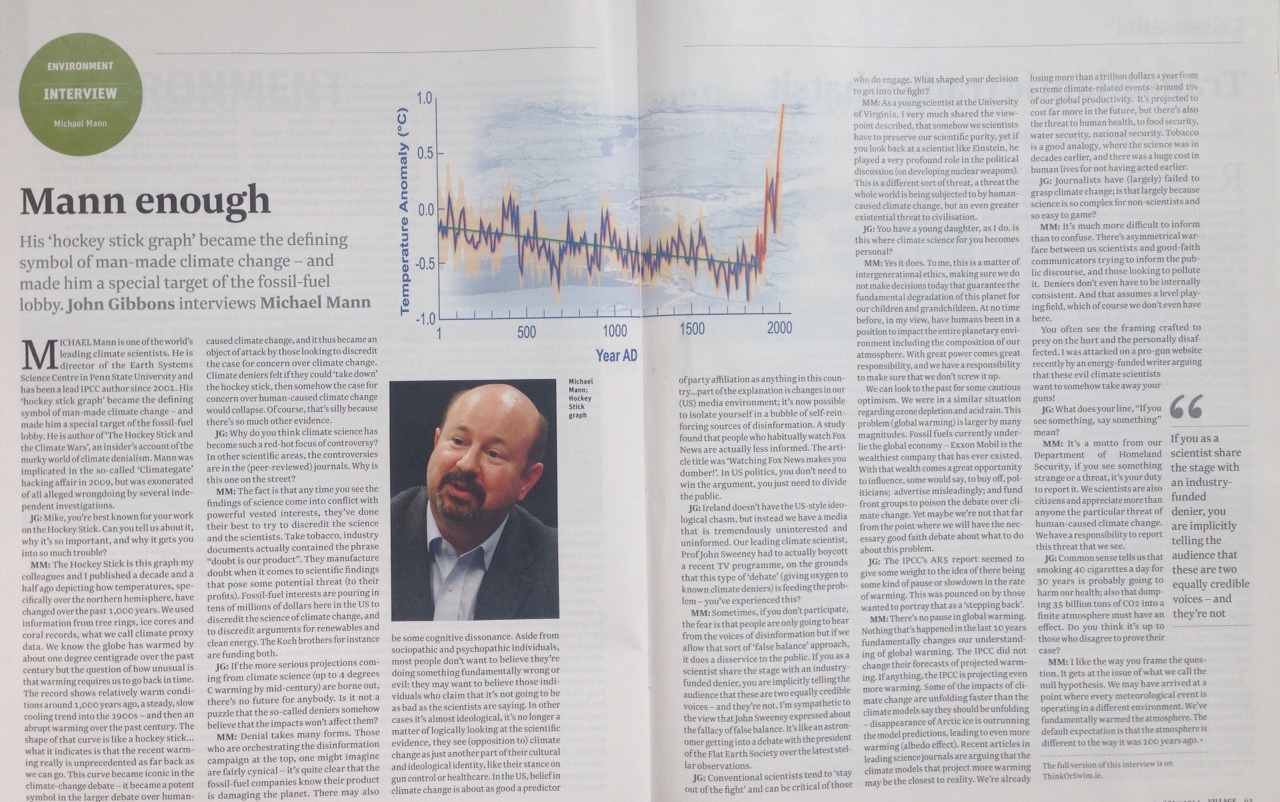
I have argued and will continue to put forward the proposition that the effective, honest and forthright communication of the reality of climate change is probably the most important work anyone, anywhere can be engaged in right now. This came up repeatedly in my recent interview with climatologist, Prof Michael Mann.
He and other top professional scientists have gradually and perhaps grudgingly come to realise that their remaining ‘above the fray’ simply left the field wide open to chancers, industry hacks and attention seekers. In the US, the situation is further complicated by how intensely politicised the science has become. For most Americans, acceptance or denial of the basics of climate science is now as clear a marker of political affiliation as your stance on the three Gs – guns, god and gays.
In Ireland, the situation is nowhere near as polarised, but from my observation, much of the fringe ‘climate contrarianism’, rather than being reflected, is in fact being generated from within the media. Some of this is conscious, but much seems to be related to a toxic amalgam of innate suspicion of ‘consensus’ in tandem with an extremely poor grasp of basic science and of how scientific understanding actually advances.
Go back two weeks, and RTE radio hosted a ‘Late Debate’ on climate change, in which I participated. Also speaking for the 97% scientific consensus was Frank McDonald of the Irish Times. Pitched against us were Eddie (‘The climate is always changing’) Downey of the IFA and Richard Tol, formerly of the ESRI and more recently making a thorough nuisance of himself misrepresenting the IPCC’s work and providing Manna from Heaven for climate deniers everywhere.
If I were being extremely polite, I’d describe Tol as an outlier, a crank and a narcissist who enjoys the limelight above all else. If I were less polite, I’d direct you to Bob Ward of the LSE, who has catalogued in forensic detail the alarming litany of ‘errors’ in Tol’s work. Strangely, Tol’s miscalculations and unfortunate jumbling up of data gleamed from other papers almost invariably lends weight to his central theme, which is to low-ball the risks and hype the costs of addressing climate change. To be fair, Tol has been at this for years, but it’s good to see his modus operandi finally receive the attention he so clearly craves.
However, for the purposes of the Late Debate, Tol was able to pretty much single-handedly swing the framing of the entire discussion from ‘what the holy hell are we going to do to address climate change’ to something of an ‘oh-yes-it-is-oh-no-it’s-not’ parlour game. The presenter lapped this faux controversy up and Eddie from the IFA purred gratefully as Tol went through his well-rehearsed contortions.
Wiser souls would no doubt have not taken the bait, but I’m clearly not that wise, and couldn’t help but wade in swinging, pointing out just how full of crap Tol et al’s 2008 ESRI projections for a never-ending boom in Ireland were, and so, on that basis, anything else he might be offering his ‘expert’ advice on should be treated with caution. And, if that weren’t reason enough to have the asbestos gloves on when handling Tol’s scholarship, this little beauty from his ESRI days in 2009, entitled ‘Why Worry About Climate Change’ will have you reaching for the whiskey and revolver. Rather than rehashing and refuting line by line the rubbish therein, suffice to enjoy instead our idiot savant’s ‘Reference’ list for the article, as follows: Tol et al, Tol, Tol, Tol, Tol, Tol, Tol et al, Tol et al.
Adrian Kelleher in Village magazine did a devastating take-down in 2011 of Tol, his dodgy GWPF friends and his even dodgier neo-liberal utterances (“new religion of climate change”, “fanatics” and “adherents of the Church of Gaia”, “economists have shown that climate change is not the biggest environmental problem in the world, denying people the catastrophe that they crave” etc. etc. etc.).
I’ll leave the last word on Tol to Nassim Taleb, author of The Black Swan, widely regarded as one of the most important books in the last couple of decades. Taleb is a world-renowned expert in risk management and assessment. “Tol is clueless about ruin probabilities. Totally clueless about risk in general: you idiots fail to understand evidence of harm and precautionary warning”, was Taleb’s devastating critique in a spiky Twitter exchange. He said much else besides about Tol too but I’ll let you look those up yourselves.
Trojan investigative work by Bob Ward and others have helped to neutralise Tol, but not before he did serious damage (as was clearly his intent) to the communication and public understanding of the IPCC AR5 report. Meanwhile, RTE’s new Agriculture and Environment Corr, George Lee has confounded those (including this writer) who feared his appointment would be long on economics and agriculture and short on environment.
I met Lee last month, when he dropped out to Dun Laoghaire to record a slot for the evening news on the release of the third and final part of the AR5 report, this one focusing on mitigation. I was impressed to find him fully up to speed and entirely engaged with the sheer gravity of what the IPCC report had to say. And he delivered it straight, no spin, no bull, no Tol.
This run continued the following day, when RTE Drivetime asked me to comment on the AR5 report. (from 02.17–02.25) Anyone who follows presenter Philip Boucher Hayes will be aware that he clearly recognises climate change as the mother and father of all crises. What made this interview unusual was the marked absence of red herrings – the interviewer asked me to set out the scale of the problem as outlined by the IPCC, as well as possible responses, plus an indication of the costs involved in choosing not to respond. The mitigation/adaptation debate is an important one, but the notion that this is an a la carte menu that humanity can dip in an out of if and when it sees fit is bunk, and Boucher Hayes seemed to be well aware of that.
So far, so good. It could not, of course, last. The following morning the Irish Independent carried an unusually ugly, ignorant piece by columnist Ian O’Doherty. I was going to do a line-by-line rebuttal of it, but on re-reading, it’s little more than the babbling of a willy-waving attention-seeker desperate for instant notoriety. The personalised nature of his attacks on Mary Robinson were, however, despicable. O’Doherty is what he is, but more shame on whatever editor actually allowed that stuff into print.
That was Tuesday. The following day, George Hook unearthed another ‘Emeritus Professor’ to wage war on reality, in the form of one Leslie Woodcock, retired from the University of Manchester and now a mainstream peddler of climate conspiracy theories. CO2, Leslie tells us, is “the gas of life”, and global warming is “absolute nonsense”.
Having been on with Hook some weeks ago for an interview in which he appeared open-minded and certainly seemed to take note that there might be something to this whole climate change malarkey, it was just a tad depressing to hear him wheel on Woodcock explain how practicing scientists have “been indoctrinated by the powers that be”. You could almost hear Woodcock’s tin foil hat crinkle as the interview progressed.
“The balance of evidence in this case is that there is no hard evidence to suggest any fluctuations in temperature are actually caused by carbon dioxide in the atmosphere – CO2 is the gas of life everything grows faster as the temperature goes up, or if CO2 goes up. There’s no evidence at all that anything unusual is happening as a consequence of burning fossil fuels the small rise in temperatures actually stopped around 15 years ago, temperatures are actually going down right now.”
At this point, George Hook appeared to have twigged that his esteemed guest might be just a little, how shall we say, potty. Â One of the hazards with getting the word ‘Professor’ before your name is that, long after you retire, and no matter how hopelessly idiosyncratic or, in Woodcock’s case, totally wrong you are, people in the media will continue to seek out your opinion to “balance” the debate that’s raging in their minds between on the one hand, the largest science collaboration in world history and on the other, a few duffers and blow-hards who love the sound of their own voices and are far beyond caring about being objective, factual or even vaguely scientific.
So much for Tuesday and Wednesday, surely the circus would at least take Thursday off? Well, not exactly. Instead, it moved to a huge piece in the unfortunately named ‘Life Science’ page in the Irish Times. The headline was catchy: ‘Galway’s drowned forests show climate change is nothing new’. And yes, they found another retired professor – Michael Williams – to set that over-excitable IPCC crowd straight on, well just about everything.
Williams is a retired geologist, and he just loves climate change. Human evolution “would not even have begun were it not for climate change not only is climate change inevitable at present the Earth is cooler, sea levels lower and atmospheric levels of CO2 are less than they have been for most of Earth history”.
Hurrah, everything is hunky dory so! What was all that rubbish a couple of short weeks back about climate change racing out of control and smashing through 2C and on towards 4C by mid-century, bringing in its wake a devastating global extinction event and catapulting Earth systems through one or more tipping points and into a chaotic new phase?
No sweat, says the retired geologist. We’ll, you know, adapt. Maybe by moving the global agricultural systems needed to feed over 7 billion humans, well, somewhere else, c’mon, there must be a couple of vast undiscovered continents we can just up sticks and move to? “Since we are the ultimate in animal adaptation humans must continue to adapt”, Williams sagely advises.
Cynics might well ask what exactly a geologist would know about human adaptive capabilities, over and above, say, the actual experts in human adaptive capability? Who knows, but, like Woodcock, Williams is a Professor and so, at least in some media quarters, that makes him an expert is all manner of things.
So what would the geologist suggest we do next? Who needs the IPCC AR5 report and its 800 authors drawn from the world’s elite of published scientists? Who needs its 2,000 page report drawing on the expertise of 9,200 peer-reviewed studies? Clearly not Prof Williams. The IPCC says that only massive mitigation at a global level can give us any reasonable chance of halting ‘dangerous, irreversible anthropogenic interference in the global climate systems’.
Bah humbug to all that. “Education and planning for an uncertain future is a substitute for panic and the spending of billions in funds to temporarily defer the inevitable. Instead, why not use the funding and our ingenuity to plan for future environmental changes?” Says Williams. Yes, cynics might well ask what a geologist knows about the “uncertain future” and the implications of “spending billions” over and above, say, the actual experts in planning for both adaptation to and mitigation of climate impacts.
Williams is of course perfectly entitled to his own opinion, however at variance his views are from the international expert consensus. These are obviously personal views, but here’s the thing: they appear on a page called ‘Life Science’, the person offering the idiosyncratic opinions is referred to as Professor. At no time did the writer of the piece, or her editor, interject to point out that Williams’ fascinating tour of paleo-climatology is completely and absolutely irrelevant to the existential conundrum a densely populated, deforested, highly polluted world teeming with billions of humans and in the grip of a mass extinction event faces in the coming decades as a result of sharp increases in global average surface temperatures on a scale and at a rate far beyond the adaptive ability of either humanity or (what’s left of) nature.
Of course, there are those who will argue that it’s not the job of the Irish Times Life Science page to only offer the IPCC ‘side of the story’ (the 97%+ global expert consensus ‘side’). But here’s the thing: this page, to the very best of my understanding, completely ignored the IPCC AR5 report, all three parts of it, in fact. On the other hand, the entirely personal opinions of one retired geologist are worthy of two thirds of a broadsheet spread, with a headline so lurid it even got picked up by RTE’s It Says in the Papers. Deniers everywhere must have been rubbing their hands in glee.
The piece was also just plain sloppy. “For example, the eruption of Krakatoa in 1883 reduced global temperatures by over 10 degrees, and it took another five years for climate to return to normal”, Siggins quotes Williams. This is out by a factor of ten. In fairness, when challenged, the writer accepted it as a slip of the pen and the online version has been updated. However, were the “degrees” centigrade or farenheit? There’s a huge difference, but who knows, since the piece (on a Science page!) doesn’t bother saying.
The Irish Times letters page carried two pieces highly critical of this article the following Monday. One, by physicist Cormac O’Raifeartaigh, states that Williams’ views are “completely at odds with the consensus of climate scientists worldwide in the first instance, the past climate changes cited by Professor Williams occurred over many thousands of years, allowing plants and animals time to adapt. In addition, these changes occurred at times of low (or no) human populations. The threat we face today is a climate that is changing over decades, not thousands of years, and the likely effects on a densely populated world”.
O’Raifeartaigh added: “It is telling that in his discussion of the ice ages, Professor Williams makes no mention of the critical role greenhouse gases played as an amplifying effect in global warming”. Another thing the good Professor seems to have overlooked is the small detail that the geological record gives us an exquisite view of the effects of sudden climate shifts.
Take the end-Permian era 252 million years ago. This mass extinction event took place in the blink of an eye, at least in geological terms. The whole episode took little more than 100,000 years. The event was triggered by a massive release of carbon. Ocean chemistry went haywire as the water acidified from excess carbon. When it was over, more than 90% of all species alive had been wiped out, and of the surviving species, their numbers were drastically reduced. It took some 10 million years for life on Earth to begin to recover its diversity.
The fossil record faithfully records the five great mass extinction events that have befallen Earth in the last half a billion years. What the sediments reveal is how devastating sudden climatic changes are on the balance of life. The great Ordovician extinction 444 million years ago is – literally – written in stone.
“The change here from black to gray (in the sediment) marks a tipping point, from a habitable sea floor to an uninhabitable one, and one might have seen that in the span of a human lifetime”, Dr Jan Zalasiewicz, a stratigrapher at the University of Leicester tells author Elizabeth Kolbert in The Sixth Extinction (a book I would very strongly recommend to Prof Williams, whose own field of expertise is, well, Sedimentology).
Ironically, the end-Ordovician extinction event was triggered by rapid global cooling. The point is that rapid shifts from the climatic norm – in either direction – are associated over and over again with extinction events. Whether the precipitating cause is a meteor strike, mass volcanic eruption or anthropogenic carbon dumping is ultimately irrelevant. What matters is the rate and magnitude of the disturbance.
As Kolbert sets out so starkly: “Right now, we are deciding, without quite meaning to, which evolutionary pathways will remain open and which will forever be closed. No other creature has ever managed this and it will, unfortunately, be our most enduring legacy”.
Prof Walter Alvarez is a highly decorated earth scientist who became famous for first developing the theory that the (non-avian) dinosaurs were in fact wiped out as a result of a global cooling event triggered by an asteroid impact some 65 million years ago that brought the Cretaceous era to a juddering end Most geologists have heard of Alvarez. I wonder what Prof Williams would make of Alvarez’ observation that the current global crisis of life is being driven not by a speeding asteroid but by “one weedy species we’re seeing right now that a mass extinction can be caused by human beings”.
Paul Price also had a hard-hitting critique of this Williams interview published in the letters page. Below are the main points he made in a comment appended to the online edition of the Irish Times, which he addressed both to Williams and to writer Lorna Siggins:
1. Can you point to the exact time frames in which average global temperature changed “by as much as 16 degrees, in time frames as short as decades”? Please state your references.
2. Can you tell us the total average surface temperature change between ice age glacials & interglacials? Surely you know that the difference was only about 4 to 5ºC and the transitions took thousands of years? This compares with humanity’s current track toward a possible 4 to 6ºC change within 200 years (IPCC AR5 WG1). Can you give evidence that this is not an extreme risk?
3. Do you think, as IPCC WG2 do, that climate change beyond adaptation limits for many regional human and ecological systems is possible by the end of this century, if radical mitigation of emissions is not undertaken quickly?
4. Are your cherry-picked, misleading, out of context factoids actually representative of your own ‘business-as-usual’ values to attempt to deny the best assessment we have of climate science as given by the IPCC. They state that business as usual is not tenable:
“Limiting climate change will require substantial and sustained reductions of greenhouse gas emissions.” IPCC AR5 WG1 p19
5. Are you really as clueless about climate science as you appear to be? Why do you apparently disrespect climate science and climate scientists to allow yourself to speak in such a misleading way from your position as a geologist non-climate-expert?
These are serious charges, and we look forward to Prof Williams or the Irish Times addressing them in detail.
I’d like to add one or two more myself:
Dear Irish Times ‘Life Science’ page, can you remind us exactly how much space you dedicated to covering publication of the three main releases of the IPCC’s blockbuster AR5 report in recent months? (hint: somewhere between ‘very little’ and ‘none at all’). Given that the IPCC is the largest scientific collaboration in the world, and only publishes its Assessment reports every seven years or so, in what way would you consider this to not be worthy of extensive coverage on a page ostensibly dedicated to science and the public understanding of science?
The editor of this section caused quite a stir last July with a front page ‘news’ story entitled: ‘Sun’s bizarre activity may trigger another ice age’. Denier website Wattsupwiththat and UK denier think tank, the GWPF both liked this story – a lot. So much, in fact, it’s now in their online ‘news’ archives.
Given that this flies in the face of just about everything we know about climate change, small wonder it made the front page. Too bad, perhaps, it was simply untrue, as Prof Barry McMullin carefully unpicked here and, far more publicly embarrassingly for the paper, the UK Guardian savaged the report here. As unfortunate coincidence would have it, another stalwart of the same Life Science page is (yet) another retired professor, William Reville of UCC, a man who brings startling levels of academic rigour to his occasional forays into environmental science: “many leading greens seem to be Marxists” or DDT “poses no health hazards” and my personal favourite: “The green movement believes in God, or more precisely, a Goddess called Gaia”, etcetera etcetera.
Meanwhile, back to the Williams interview. Here, I have to agree with the comments Paul Price made in his letter to the Irish Times: “(Williams’) unscientific cherry-picking of a series of geologic and ice age climate facts created a highly misleading picture that is entirely irrelevant to the mitigation and adaptation decisions required by us now ‘Opinion’ pieces by non-experts may be acceptable for politics or entertainment but on a matter of science, and one of such grave import for all our futures, knowledgeable, critical reporting is required. it is the responsibility of The Irish Times and its reporters to have sufficient critical and fact checking ability to avoid supplying the public with badly misleading information on climate change, just as would be expected in reporting vaccination for example.
“At the very least reporters should read the IPCC report summaries. Climate change affects all our futures, therefore our media need to work much harder and contact climate scientists for help when writing climate stories to ensure accuracy. Otherwise journalism betrays our trust in this pivotal decade.”
Surely, after five full IPCC reports and countless thousands of peer-reviewed papers over the last two decades or so, that’s not too much to ask?
The Irish Times delivered its response to the challenge thrown down by O’Raifeartaigh and Price, in a manner of speaking, by running two letters from out and out climate change deniers a couple of days later, including a serial denier, David Whitehead, associated with a Flat Earther grouping calling itself Turn 180. Its stated aim: ‘is to inform the Irish public that Carbon Dioxide is not a pollutant, nor is it the cause of Global Warming’ (yawn).
Whitehead wasted no time in labelling people who do not share his anti-science views as “shrill, hysterical, ignorant”. Another letter writer chimed in: “the thought police are on the warpath again – a lone voice queries the popular assertion of “climate change” and is condemned in tones reminiscent of Animal Farm I find myself wondering whether “global warming” might not simply be the latest iteration of atavistic superstition.”
In the interest of yet more ‘balance’, further responses from both Price and O’Raifeartaigh were published a couple of days later and so the merry-go-round spun on and on. A letter drawn up by An Taisce’s newly formed climate change committee (disclosure: I’m a member) and signed jointly by Barry McMullin and James Nix was submitted but, sadly, not published. It was headed: ‘Honesty and integrity in climate science reporting’.
Among the points it addressed were:
“To maintain trust, and to properly serve the society that sustains them, our public media need to embrace their responsibility to reflect honestly and accurately the overwhelming scientific consensus on the core findings of climate science and the scale and urgency of the human predicament this science describes. The status of this scientific consensus must be clearly distinguished from mere shared opinion, ideology or, worst of all, “groupthink” – indeed, it is the very opposite.
“Consensus among a large, diverse and distributed group of scientific experts is achieved only through the most intense, prolonged, severe and transparent processes of critical review, experiment and argument, all directed with the explicit aim of uncovering any conceivable weakness or error. Science does not and cannot deliver unambiguous or definitive “truth” on any issue – it is always open to new challenge, refinement or correction: but it is the very best approach yet discovered to identifying and eliminating error.”
The letter concluded by urging Ireland’s Paper of Record to follow the lead of the Los Angeles Times and Sydney Morning Herald among other media who have recently introduced explicit policies to refuse to give oxygen to deliberate misrepresentation of climate science. In a nutshell, that means refusing to run material that promotes demonstrable falsehoods, such as Whitehead’s letter. Maybe it’s reading too much into the decision of the paper not to publish this considered official response from An Taisce, but it does suggest the paper may not yet ready to fully take on board its own Editor’s Statement, which includes the following: “Above all else, we commit ourselves to accuracy; the most essential test of our profession”.
More broadly, quite how you overcome the mindset among some in journalism that gleefully showcases irrelevant contrarianism in a way that is clearly designed to dent public confidence in the reliability of climate science and the need to take urgent, far-reaching actions to avert disaster is perhaps another day’s work.
Trying to unpick media coverage on a moving point like climate change is a tricky and thankless pursuit, and yet it remains critically important. It’s only by calling our media to account, over and over again, that we can hope to see any progress, however slight, in the accurate communication of climate science. After all, it’s not like our lives don’t depend on it.